Content on this page requires a newer version of Adobe Flash Player.

Get Adobe Flash player


Search in the Encyclopedia

Dieren en planten

Birds   Bird Protection   Seabirds   Oil victims   
Oil-covered guillemot, Texel, Ecomare

Oil victims

It is a pitiful sight: seabirds covered in oil. These birds are no longer able to dive or float because the oil causes leaks in their plumage. The oil makes their feathers to stick together, permitting cold water to reach their skin. In that case, oil victims generally become undercooled. Most oil slicks do not originate from a stranded tanker. They come more often from purposely (and illegally) dumped oil, or unintentional leakage. Oil victims are cared for at bird rehabilitation centers.

  • Every victim is one too many

    From 1970 to around 1986, many oil victims washed ashore on Dutch beaches. Since then, the number of birds covered in oil has declined. Apparently, there is less oil floating about at sea, partially thanks to the MARPOL treaty. However, the number of Dutch 'oil birds' is still high compared to the other countries surrounding the North Sea. For example, the European goal is less than 10% of the total number of oil victims washing ashore is guillemots, but results show 50%. The counts come from the Beached Bird Survey performed by Kees Camphuysen, in commission of the Ministry for Transportation.

  • Contact with the oil: catch a cold or drown
    Guillemot, covered with heavy fuel oil, Ecomare

    When a bird comes in contact with oil, it does not mean imminent death. However, the bird's plumage is no longer waterproof. The animal loses its insulation and catches a cold. Its floating ability also diminishes; the bird can even drown. In addition, it is known that brooding eggs from a bird besmeared in oil have fewer chances of hatching. The kind of oil, the time of year and the place of the oil contamination determine the extent of the damage. Heavy ('thick') oil floats longer on the water surface than light oil, which evaporates more quickly or mixes more naturally in the water column. Therefore, a heavy oil spill can cause more damage to birds and other sea life.

  • Cleaning oil victims
    Guillemot in a bird washing machine, Ecomare

    Every year, tens of thousands of oil victims wash up on the shore. This is usually only a small fraction of the total number of birds affected by oil; most of them never wash ashore. Those that are still alive are brought to special bird rehabilitation centers, which have facilities and guidelines for caring for the oil birds. Ecomare on Texel is one such bird center. Not all that many years ago, approximately 500 birds were cared for every year; nowadays the numbers are several dozen. Other larger bird rehabilitation centers in the Netherlands are in Middelburg, Rotterdam, Haarlem and Anjum.

    The birds are washed with a special detergent. Afterwards, they must regain their strength and wait for their plumage to become waterproof again. After an average of two months, they can be released back to the North Sea. Caring for birds is like mopping with the oil tap open. Naturally, it is much more important to stop the oil pollution.

  • Studying oil victims in the Netherlands

    The Dutch Fuel Oil Victims Study (NSO) was started in 1977 and is now one of the activities performed by the Dutch Seabird Group (NZG). Counting oil victims on beaches is not new. The Dutch Youth Group for Nature Studies (NJN) has been organizing counts on the beach since 1960. There is even data from counts since 1915, officially the first year that oil victims were found in the Netherlands.
    Volunteers spread throughout the country counts fuel oil victim throughout the year, although the emphasis is in the winter period. Nearly three-fourths of the cases of oil pollution have been identified coming from oil mixtures discharges. That implies discharges taking place after cleaning the tanks. Crude oil, originating from wrecked tankers or accidents by oil rigs, is rarely found on Dutch beaches.
    Nowadays, the number of oil victims that wash ashore is much less than in the 1930s. When studying all the species and groups of shore bird and seabird victims, scientists have been able to explain the reason for decline. Assuming that bird habits have not substantially changed and that their distribution at sea has also not been subject to major changes, the Seabird Group concludes that the amount of oil at sea in particular determines the chances of coming in contact with oil.

  • Winter ailment

    Most oil victims along the Dutch coast are found in the winter. The birds already have to deal with low temperatures, storms and much less available food. With regular stormy winds and shorter days, the winter is the time of year when fewer controls of illegal discharges from ships take place. Every skipper who dumps oil into the North Sea during a storm knows that the chances of being caught are slight since it is impossible to prove anything once the controls restart after the storm has subsided.

  • Risky

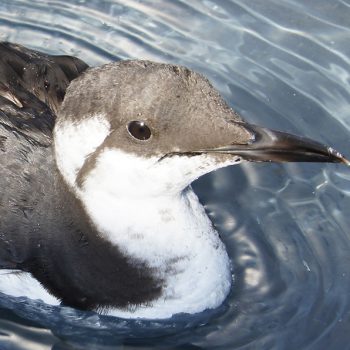
    A small oil slick in an area rich in birds can cause many more casualties than a large slick elsewhere. Seabird species that spend lots of time on the surface of the water are usually the most vulnerable. They readily swim into a slick or emerge into one after returning from a deep dive. Guillemots are very sensitive to oil pollution. With the exception of a short period in the summer when the chicks are being bred on steep cliffs, these birds are always at sea. They spend most of their time swimming. Because they spend the winter on the heavily trafficked North Sea, large numbers come in contact with oil every year.

    Guillemots and razorbills have additional risks after breeding season. The parent birds molt during this period - all their primary feathers at the same time - and are then unable to fly. The chicks jump into the water before they can fly. In this state, parents and young can swim hundreds of kilometers before being able to fly (again). However, it is impossible for them to flee from an oil slick.

  • New woes

    Although oil pollution has declined immensely, a new problem has emerged to take its place. It began in March 2010 when dead birds washed ashore. Not only were they completely covered in a sticky substance, their feathers and wings were glued stiffly to their body so that they couldn't move anymore, let alone flee. It was unclear what the substance was, possibly something used to clean  cargo tanks of chemical tankers.