Content on this page requires a newer version of Adobe Flash Player.

Get Adobe Flash player


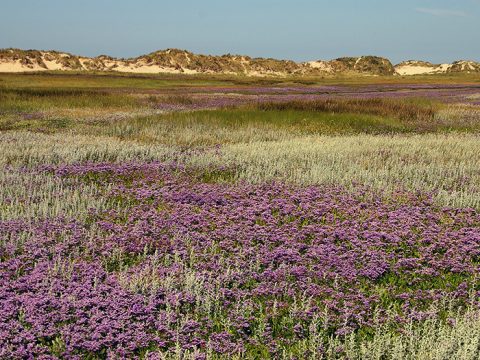
Dune flora, Foto Fitis, www.fotofitis.nl

Dune flora

The dunes are made up of various kinds of areas: young and old dunes, slacks and grasslands. Each area has its specific vegetation. The flora of the wind-blown beach ridge cannot be compared to flora found in young dune slacks lying behind this ridge. The one consists mainly of marram grass, lyme grass and maybe even sea holly while the other contains elderberry and sea buckthorn bushes. There is also a large difference between the vegetation on the northern slopes (moderate climate, lots of crowberry and ferns such as common poylpode), the southern slopes (strongly varying climate, lots of lichens) and dune plains (primarily heather).

On Texel


, Sytske Dijksen, www.fotofitis.nl

Many of the dunes on the island have been leached of calcium, putting them in the category of old dunes. Compared to the other Dutch Wadden Islands, there aren't that many dune slacks that flood in the winter which also influences the vegetation. The young dunes found in the Muy, along the beach ridge and on southern part of the island have a rich vegetation, with grass of Parnassus, orchids and yellow-wort. Although not as proliferate as on Terschelling and Vlieland, there are several places on the island where cranberries grow.

  • Dune formation
    Wind-blown hawthorn in the winter, Foto Fitis, www.fotofitis.nl

    Dunes are constantly changing. Wind adds new minerals, rain drains them away. The species of plants that grow react to the consistency of the dune soil. This process of change is called succession. It begins on the beach with sea rocket and sand couch, both of which germinate in the flood mark on a flat sandy surface. Once these plants take root, they catch sand which eventually forms into a dune. When this mound of sand traps fresh water, other plants such as marram grass will take root. As more and more sand is retained, other plants will germinate in the sheltered spots, such as sea holly and sand evening primrose.

    Moving more inland in the shelter of the first row of dunes, sea buckthorn flourishes. Many of these thorny bushes bunched together form impenetrable 'woods'. Sea buckthorn is an important plant for the dunes because it adds lots of nitrogen into the soil. There is more than enough for sea buckthorn itself, so that other plants also profit. In the area surrounding sea buckthorn, you often find a ground cover of stinging nettles and blackberries, followed eventually by elderberry.

    Many of the plants die in the winter, producing lots of humus in the ground. This means even more food for other plant species. The more nutrient-rich the soil, the fewer flowering plants and the more grass species. Thick mats of grass and moss 'fix the dunes', protecting them from erosion. The composition of the dune soil has changed from nutrient-poor and calcium-rich sand to nutrient-rich and calcium-poor soil.

  • Heather boundary
    Honeysuckle, Foto Fitis, www.fotofitis.nl

    Should you walk from north to south through the dunes of North-Holland, you are bound to notice a remarkable difference in vegetation once you pass Bergen-aan-Zee. The dune sand south of this boundary is rich in calcium and other minerals while the dune sand to the north is much poorer. The most obvious sign is the presence or absence of heather. Spindle, poplars, oak and beech grow in the dunes south of Bergen while large fields of heather flourish in the dunes to the north. This boundary is often referred to as the heather boundary.

    The sea sand in young dunes contains so many minerals that heather won't grow. These plants will only get a chance to take root once the dunes have grown older and rainwater has flushed the minerals deeper into the ground. That is why you only find heather growing in older dunes.

    Dunes along the beach ridge are young. No matter whether they are north or south of this boundary, these dunes will not differ much from one another plant-wise. Wind and water are dominant factors here, bringing fresh loads of elements ashore which eventually reach the beach ridge. Sometimes you find plants growing in older dunes which are characteristic of calcium-rich dunes. Thanks to walking trails made from crushed shells, a local supply of calcium allows plants such as vipers bugloss and sand-hill screw-moss to grow here.

  • Northern and southern slopes

    Besides differences between young and old dunes, there are also obvious differences between the vegetation growing on northern and southern dune slopes. Northern slopes are cooler and shadier while southern slopes have to deal with direct sunlight. The temperature can vary strongly from cold at night to 50 degrees Celcius during the day. The soil can be very dry for long periods. Not many plants can deal with such tough and varying conditions.
    Heather, crowberry and common polypody are especially typical for northern slopes, while southern slopes are dominated by marram grass, grey hair grass and lichens. Once rabbits discover a southern slope, they add nutrients which allow other plants to flourish, despite the tough conditions. Heath dog violet, lady's bedstraw and common milkwort are examples.

       
    wind-blown beach ridgedune slacks
    marram grass

    lyme grass

    sea holly

    sea rocket

    sand couch

    sea sandwort
    grass of Parnassus
    wintergreen
    marsh helleborine
    autumn gentian
    glossy eyebright
    bog pimpernel
    older dunes 
    rowan
    creeping willow
    hawthorn
    burnet rose
    honeysuckle
    moss
    heather
    common polypody
    lichen
    orchids
    silver birch
    heath dog violet