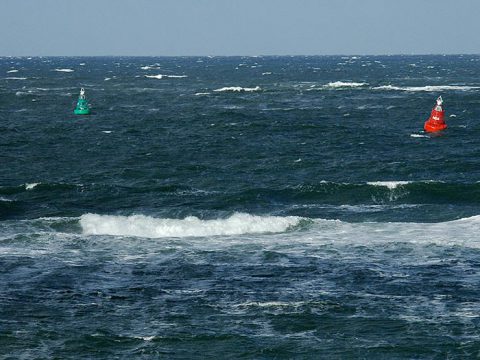
At the Dumpsite North (Loswal Noord), 5 kilometers off the coast of the Hook of Holland, around 14 million cubic meter of dredged material from the Euro-Maas channel and the western harbour region of Rotterdam was dumped annually till 1996. Ultimately after fifteen years, 100 to 150 million cubic meter of light to moderately polluted dredged material (class 2 and 3) can be dumped on the 'Slufter' of the Maasvlakte.
Dumping in Dumpsite North ended in 1996, and a second depot, Dumpsite North-West, was opened. When this new dumpsite was opened for usage, the need evolved to get more insight into the environmental effects of dumping dredged materials. Research was performed by the NIOZ. After one year, the benthic fauna on the old dumpsite North appeared to be recovering and the grain size of the sand had increased. At the new Dumpsite North-West, however, the benthic fauna had declined and high silt concentrations were encountered.
After dumping dredged material at Dump-site North, only 20% of the sludge remained on the bottom. Around 40% was transported back to the Nieuwe Waterweg with the currents. And almost the same amount of sludge was carried by the currents along the coast northwards, in the direction of the Wadden Sea. At this point, it was mainly fine-grained sludge, and that's where the most pollution is found.
There are still too many heavy metals present in harbour sludge, especially zinc and copper. There are also many polycyclic aromatic hydrocarbons (PCBs), as well as tributyltin, the toxic part of anti-foul paints which used to be applied to ship hulls. The washout of the polluted mud contributes 15% to the level of heavy metals in Dutch waters and for 40% to the levels of organic micropollutants. This influence decreases in a northern direction and contributes between 5 to 15% of the heavy metals and between 10 to 20% of the organic micropollutants in the western Wadden Sea. Since in this manner Dump-site North contributes to the contamination of the North-Holland coastal water and the Wadden Sea, studies are now being made for future use of a deeper storage depot: a pit in the North Sea bottom which can be covered with clean sand after dumping the dredged specie.