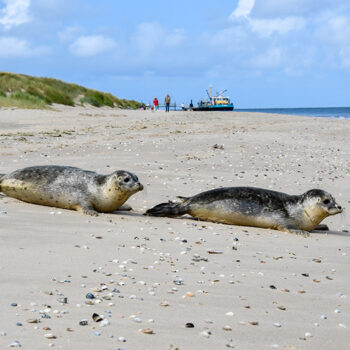
The actual consequences for nature will only be apparent after a period of time once the wind turbines are working. However, the situation before the placement was charted on a large scale, so that the distribution of benthic animals, fish, marine mammals and birds is known prior to placement. Now that one park is in operation, the study will be repeated in the near future. Since no fishing is allowed in the vicinity of the parks, fish will probably find the parks a safe refuge.
When constructing offshore wind parks, it is possible that damage occurs to the hearing organs of marine mammals. Porpoises can become victims of extremely loud noise when ramming in the poles for the turbine foundation. These poles are hammered 30 meters into the sea bottom, which means using heavy material to accomplish the task. Although the contractor uses pingers to chase the porpoises away, it has not been proven whether it is sufficient. There is little experience with these kinds of effects. Studies of hearing organs in washed up porpoises will show whether or not the animals are victims of such activities.
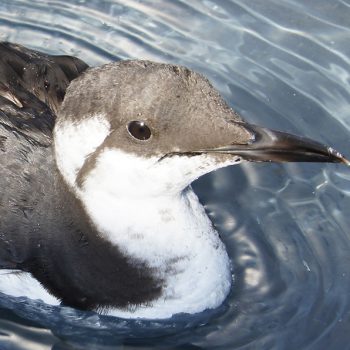
It is still unknown what the effects of wind turbines will be on birds flying above the North Sea. One option is that they will be chopped to pieces by the vanes. The score in Denmark (where offshore wind parks have been standing since 2002) a year after the opening in of one of the parks, is the following: the birds stay a long distance away from the turbines during the day, but fly closer at night due to non-visibility. A number of birds fly into the vanes, but it is assumed that it is not a dramatic amount. Another consequence is that migrating birds must fly around them, costing extra energy that could lead to a less successful nest. As of yet, no studies have been done in this field.
In the Netherlands, a test arrangement to register the number of birds that fly into a turbine has been placed. Four microphones register the noise of the turbine and a video camera starts filming when a strange noise is heard. The images are sent to a computer on land, where ornithologists determine which bird it is.