The fish production in the world has been rising rapidly since 1990 more from fish farming than from fish catches. Production of farmed fish grows with more than 9% per year and the expectation is that there will be more farmed fish on the market than wild fish by 2025. In the meantime, around 50% of all fish, shellfish and molluscs come from aquaculture. Without this growth of large-scale aquaculture, fish would become scarse for the consument and only available for the highest incomes.
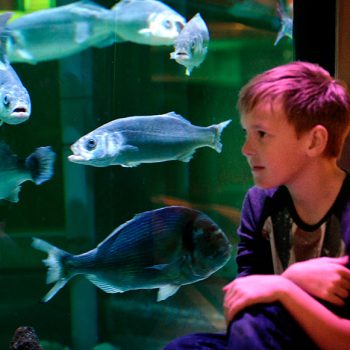
The Netherlands is also doing many experiments with farming fish. Dozens of farmers have switched over to fish, such as eel, trout and catfish. In Groningen, there is a fish farm which yields 350 tons of eel per year, which is more than the fishermen in the IJsselmeer catch. In the entire country, around 4200 tons of eel and 4500 tons of catfish are farmed yearly. A fish farm in Groningen started in 2005 to farm barramundi, an Australian bass species. The Barramundi Farm in Urk began in 2007 and The Happy Shrimp Farm began in 2006 on the Maasvlakte near Rotterdam. Cultivating sole is still a problem. According to fish farmers, farming sole is just as attractive as difficult. Sustainable farming of fish and other animals is stimulated by the Innovation Platform Aquaculture.
According to Greenpeace Netherlands, fish farming can be sustainable as long as wild fish are not caught to serve as food for farmed fish. From 2000 to 2007, the amount of fish used as fish food increased by 50%. Secondly, the use of medicine in fish food should not be a threat for human health. Finally, sustainable farming must take place in closed systems so that farmed fish cannot mix with wild populations. Momentarily, sole and tilapia are being farmed in a sustainable manner in Zeeland.