Content on this page requires a newer version of Adobe Flash Player.

Get Adobe Flash player


Environmental quality of the Wadden Sea

The environmental quality of the Wadden Sea can be measured by various factors. How diverse the region is in plant and animal species gives a good indication as to the quality. This diversity is summed up as 'nature quality'. There are five major factors which influence the quality of the Wadden Sea: eutrophication, pollution from other industrial materials, shellfish fisheries, recreation and land reclamation. Marine mammals and bottom-dwelling animals have recovered the best. Climate change when caused by man is also a factor which influences the quality.

  • Nature quality and other factors

    Despite increasing recreation, the nature quality of the Wadden Sea in 2008 has increased since 1990 thanks to regulations. Water quality in particular has improved, which has influenced the plants and animals living there.Eutrophication supplies the Wadden Sea with an overabundance of algae. Together with suspended matter, the algae make the water too turbid for seaweed to develop well. However, studies show that in the 21st century, eutrophication is declining thanks to the cleaner water in the Rijn which is supplying fewer nutrients. The level of phosphate in particular has declined. The amount of nitrate, another important nutrient, has not declined. The concentration of ammonia and nitrite is still a factor of three to five times higher than in natural water. In general, the southern Wadden Sea is more eutrophicated than the northern part.
    Pollution from other materials: Concentrations of heavy metals are either declining or remaining stable. Industrial materials, such as PCBs, TBT and pesticides are found less often. Concentrations of the most polluting materials are still (sometimes much) higher than the target values, such as bromide flame retardants. The long-term effect of these materials, just like that of hormone-disruptive materials on organisms, is still unclear.

  • Oil pollution and seabirds

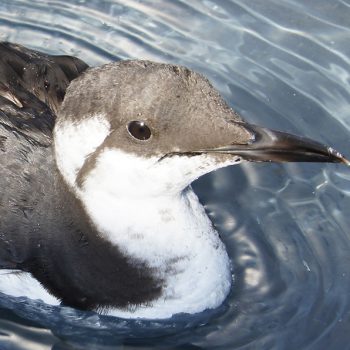
    Oil pollultion has declined since 1990, but still remains a danger for birds. The number of oil victims per kilometer coast is less along the Wadden Sea than along the North Sea. The target is to decrease the number of oil victims to 10% of all the dead birds found on the beach. That target is far away. Oil disasters cause a temporary increase in the number of dead birds.

  • Disturbances

    Shellfish fisheries put a lot of pressure on the mussels and cockles. Stable wild mussel banks no longer exist. Cockle banks had been deteriorating up till 1998, partially due to poor spatfall the previous years. Eelgrass fields have declined tremendously and have not yet recovered. The disturbance of the bottom due to mechanical shellfish fisheries has ended, but other forms of fisheries are still causing disturbance.
    Recreation places a heavy pressure on breeding grounds for birds. A number of species, such as terns, are flexible enough to move to other areas, but this does not apply to other species such as the Kentish plover.
    The historical land reclamation of the Wadden Sea has given the avocet opportunities to find more breeding grounds. However, the waterworks impede development of new eelgrass fields. Smelt and other migrating fish are hindered by the closure of the routes from sea to fresh water. Migrating to spawning grounds grows more difficult all the time.
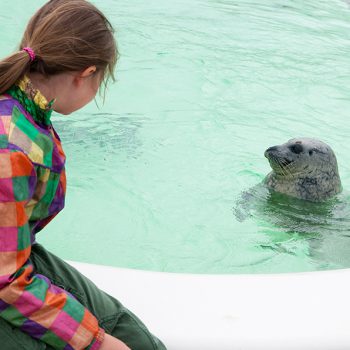
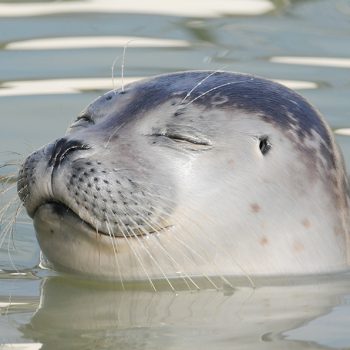
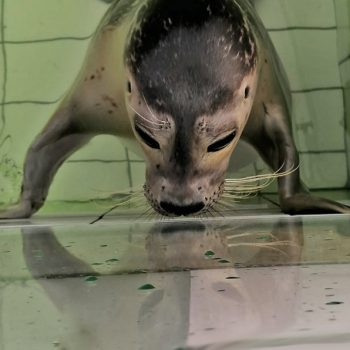
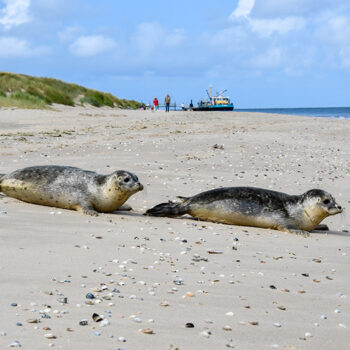
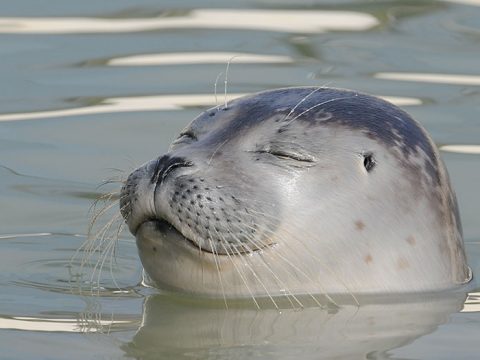
    Birds still do not have enough areas to rest or molt. Worm-consuming birds have increased while shellfish-consumers are back to the level of 1990. The seal population continues to grow since the previous virus epidemic of 2002.

  • Salt marshes

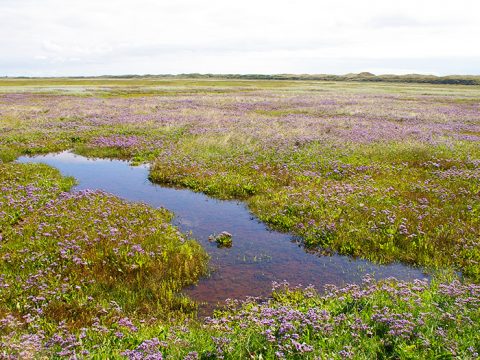
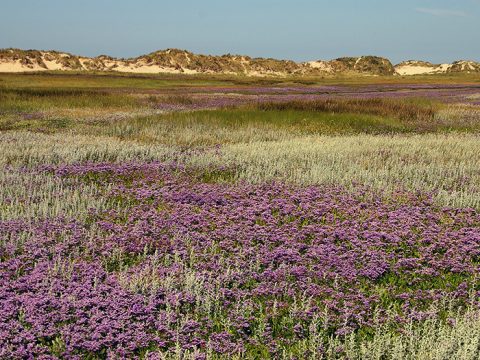
    Nowadays, salt marshes are left alone to develop naturally. They used to be artificially drained and grazed. Natural vegetation is increasing thanks to new policy. The target is to allow more marshes to evolve. The surface area of salt marshes have increased since 1990, although the necessary 15,000 hectares for a 'good ecological situation' (according to the Water Framework Directive) is still far from reality. This is equivalent to 6.7% of the surface area of the Wadden Sea. The present area is 6200 hectares.

  • Tidal flats

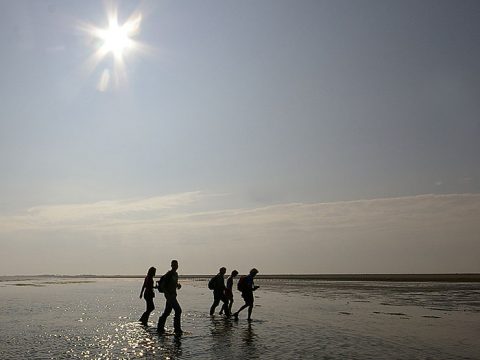
    The tidal flats are still characterized by high natural dynamics. In other words, nature is allowed to do its own thing in many places. Once in awhile, there are human disturbances such as dredging navigational channels, constructing dikes and recreation. Another form is disturbance of the bottom. An example is the cockle fisheries which occurred up through 2005 and had unfavorable consequences for spatfall of shellfish, such as Baltic tellin. Policy is directed at limiting this kind of bottom disturbance.
    In the past, natural mussel banks and eelgrass fields decreased enormously. Stable old mussel banks are a rare occurance in the Dutch section of the Wadden Sea. That has not always been the case. In 1976, there was a surface area of almost 4200 hectare stable mussel banks distributed over the Wadden Sea. In 1997, there was around 100 hectare left. The target is to allow these structures to return. Although the areal of mussel banks in 2007 had grown to 1865 hectare, it is still less than the desired development. This is true for the Sabellaria reefs as well. Nature seems to develope better in areas where no fishing is allowed, compared to where fishing is taking place. Re-introduction programs of eelgrass (Zostera) in 2002 have had fluctuating success. There is little left of seawrack (Zostera marina) while small fields of dwarf grass-wrack (Zostera nana) on the Balgzand are developing.