Content on this page requires a newer version of Adobe Flash Player.

Get Adobe Flash player


Search in the Encyclopedia

Dieren en planten

Water en land

Mens en Milieu

Safety at sea   Accidents at sea   Andinet   Prestige   Tricolor and Assi Eurolink   
Bumpers from the load Tricolor, Dirk Bruin, Noordwester Vlieland

Accidents at sea

With an average of 24 serious accidents per year, the Dutch section of the North Sea is referred to as a relatively safe sea, certainly when one considers the enormous amount of activity which takes place in the navigational lanes. In this region, 60 to 90 accidents occur annually which are so serious that help is requested by the Directorate North Sea.

  • Busy North Sea

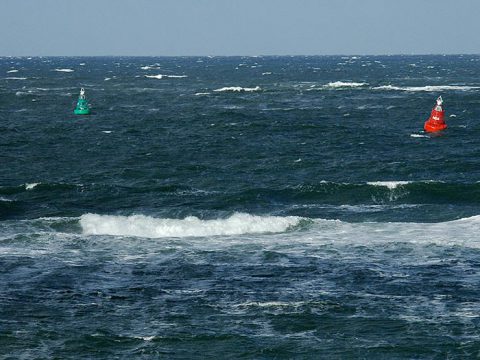
    The North Sea is one of the most intensively sailed seas in the world. To say nothing of the fisheries, suppliers for drilling platforms and use by the navy and recreation, 124,000 ship movements take place per year in these waters. That means that an average of 340 ships sail in the Dutch section of the North Sea at any arbitrary moment of the day. Navigation routes have been marked to decrease the chance of accidents.

  • Shipping accidents

    Shipping accidents occur due to collisions (52%), strandings (18%), fire/explosions (9%), sinking (2%) and several less important happenings. Fishing vessels are involved in the most accidents in the North Sea, followed by cargo ships. Tankers and ships with liquid cargos are involved with less than 10% of the accidents at sea. However, materials are readily discharged into the marine environment should an accident occur with this last group. offshore installations also form a source of risks.
    These accidents cause an average of three deaths per year and once every other year, there is a substantial amount of damage for the environment. In most of the incidents, an accident is caused by a combination of factors. In 65% of the cases, human failures are (partially) responsible; 50% of the time, technical sailing causes are relevant; 35% of the time, poor weather conditions play a role and in 20% of the time there is a question of deficiencies on the ship and/or in the cargo.
    The chance that a ship has an accident in the Dutch section of the North Sea is 1 per 1700 trips. The chance of an oil disaster with more than 30,000 cubic meters of oil is once every fifty years. The chance of an oil disaster with more than 50,000 cubic meters of oil is once every 200 years. Losing control of the wheel occurs an average of 30 times per year in the North Sea. This ships are referred to as drifters. Drifters are dangerous in the navigational lanes and can collide with offshore platforms and offshore wind parks.

  • Summary of serious accidents
    date name type location cause nature/ environment
    12-2003 Andinet cargo ship NW Texel storm and improperly stowed cargo loss of around 700 drums of heavily toxic Wolman salt
    01-2003 Assi Euro Link   50 km NW Terschelling collision leakage bunker oil: many oil victims among seabirds
    12-2002 Tricolor auto carrier English Channel collision leakage bunker oil: many oil victims among seabirds
    12-2001 Sloman Traveller chemical tanker 18 km N Vlieland fire on board chloride gasses in atmosphere
    10-1998 Pallas cargo ship sandbank near Amrum fire aboard bunker oil in sea: many victims among seabirds
    03-1994 Sherbro container ship English Channel containers overboard dangerous agricultural toxin Apron Plus on the beaches
    03-1993 Mairbritt Terkol chemical tanker 20 km N Vlieland   explosion of chemical tank
    01-1993 Brear oil tanker Shetland Islands collision with rocks after technical disturbance 85,000 tons of raw oil in sea: due to storm, relatively few victims among marine fauna
    10-1992 Nordfrakt cargo ship 10 km W Noordwijk unknown 2 tons lead sulphide in sea
    04-1992   oil tanker English Channel collision loss of lots of palm oil; many victims among marine fauna
    03-1992 Long Lin oil tanker near Zeebrugge collision with Cast Muscox lots of oil in sea
    03-1992 Cast Muscox bulk carrier near Zeebrugge collision with Long Lin lots of oil in sea
    1991 Clipper Confidence bulk carrier   collision with Norgas lots of oil in sea
    1991 Norgas chemical tanker   collision with Clipper Confidence lots of oil in sea
    1990 Rose Bay oil tanker English Channel collision with fishing vessel lots of oil in sea
    1988 Anna Broere chemical tanker 100 km W IJmuiden   leakage of hundrede of tons of Acryilonitril
    1987 Borcea bulk carrier seaward of the Zeeland coast   leakage bunker oil
    08-1984 Mont Louis cargo ship seaward of the Belgium coast collision with ferry loss of radioactive load
    01-1984   cargo ship Doggers- bank   loss of 67 barrels Dinoseb
    1983 Vostosc II cargo ship near Vlissingen collision with wreck leakage bunker oil
    12-1982 Erato container ship Wester- schelde collision with Yumpa lots of oil in sea
    12-1982 Yumpa container ship Wester- schelde collision with Erato lots of oil in sea
    1982 Katina oil tanker near Hook of Holland collision with Pengall lots of oil in sea
    1982 Pengall bulk carrier near Hook of Holland collision with Katina lots of oil in sea
    1982 Benetank oil tanker Wester- schelde collision lots of oil in sea
    1981 Cristel Hermann cargo ship seaward of the Holland coast   loss of 60 barrels of hydrochloric acid
    1975 Olympic Alliance   southern North Sea collision 8000 tons oil in sea
    1974   oil tanker near IJmuiden   large oil slick, many victims among seabirds
    1971 Elizabeth Knudsen oil tanker   collision 100 tons oil in sea
    1970 Pacific Glory oil tanker southern North Sea collision 900 tons oil in sea
    1969 Texaco Westminster oil tanker   defects on board 500 tons oil in sea
               
  • European regulations

    The demands ships must satisfy have been established on a European level. Ships are inspected in order to control whether they satisfy the demands. If that is not the case, then they end up on a black list and are refused in harbours. In order to increase the safety of ships even more, the European Commission presented the Erika-3 package, seven proposals that follow from earlier decisions for better hulls of tankers and larger punishments for neglectful shipping personnel. The first proposal is that Brussels wants to increase the responsibility of the ship owners. Presently, the owners are only partially responsible for disasters, whereby victims cannot always receive compensation for damage. Furthermore, ships must be insured, since some ships are completely uninsured. In addition, a black list must be made of ship owners that allow poorly maintained ships to sail. An information system has been set up in order to keep track of ships in Europe: harbours can keep others informed about the departure and destination of ships via the Safe Sea Net.