Content on this page requires a newer version of Adobe Flash Player.

Get Adobe Flash player


Search in the Encyclopedia

Dieren en planten

Water en land

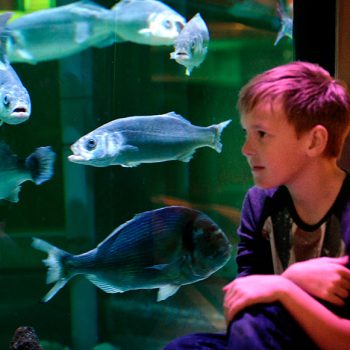
Fish assortment in the store, Ecomare

Fish stores and quality labels

The Dutchman eats an average of 3.6 kilograms of fish per year. In that respect, he is a very modest fish consumer, considering that the average person consumes around 17 kilograms per year. The Japanese are the champion fish consumers with 72 kilograms per person per year. The Japanese are the champion fish consumers, with 72 kilograms per person per year. Because fish contains many vitamins and 'healthy fats', Dutch nutrionists recommend eating twice as much fish and less meat. Fish consumption has risen slightly over the past few years in this country, especially since it is possible to buy farmed salmon and mussels in the supermarket. Because many fish species are endangered, it is good to know which species are sensible to eat. The North Sea Foundation has made a list showing which fish are caught in a sustainable manner.

  • MSC quality label for good fish

    Throughout the world, many species of fish are overfished. The FAO estimates 32%, some lobby groups presume 80%. Whatever the amount, it is important to know which species are caught in a sustainable way. The leading international standard for sustainable fish is issued by the Marine Stewardship Council (MSC), founded in 1997 by the World Wildlife Foundation and Unilever. In the Netherlands, the quality label can be found on pollack products (such as fish sticks) from Iglo and packaged North Sea herring. Dutch fish stores can also receive an MSC quality label. In order to receive an MSC certificate, the catch must meet a number of conditions:
    - there must be a healthy fish population,
    - fishermen must operate with a sustainable catch method (no bycatch; no damage to nature and the environment),
    - there must be a balanced and controlable system for management and registration.

    In 2008, around 8% of all sea fisheries for human consumption had received an MSC certificate. More than 40% consists of salmon and cod species. There were more than 30 fish products on the Dutch market with an MSC label. The amount is growing rapidly. In 2011, the following fish species with MSC labels on the market were:

    Fish speciescatch areacomments
    Shrimp West coast USA, East coast Canada North Sea shrimp have no quality label
    Herring Atlantic Ocean, North Sea all Dutch herring have MSC
    Hake South Africa  
    Halibut West coast USA  
    Cod Barents Sea, Alaska  
    Pollack North Sea, Barents Sea  
    Langoustine Scotland  
    Mackerel Atlantic Ocean, North Sea  
    Mussel Denmark  
    Sardine Portugal  
    Haddock Norway  
    Plaice North Sea when caught with twinrig or flyshoot
    Sole North Sea when caught with standing rigging
    Salmon Alaska  
    Swordfish Canada  
         
  • 'Wise' Fish Guide

    The North Sea Foundation publishes the Fish Guide together with the World Wild Life. This is an summary of every species of commercial fish and rates whether or not it is wise to eat it. The information is continually changing, since first one species is being threatened and then another species. The newest updates can be found on the website. A small wallet-sized version can be downloaded.

  • Organic fish and 'Waddengoud'

    Because it is impossible to know how a fish has lived in the wild and what kinds of unnatural substances it has ingested, the Dutch EKO quality label for organic fish is only issued for farmed fish. In that case, salmon is the only fish that qualifies since this species is farmed on a large scale on organic farms. Most of these farms are located in Ireland. Organic pangasius is farmed in Vietnam.

    Seafood with a Waddengoud (wadden gold) logo is not necessarily farmed organically. It must be caught or harvested in the wadden region in an environmentally friendly manner. These products are usually sold to the more prestigious restaurants on the islands and along the wadden coast. Examples are smoked mullet and hand-gathered oysters and cockles. Even the wadden shrimp that are peeled on Texel also have the Waddengoud logo.

  • Run on quality labels

    The MSC, EKO and Waddengoud labels are only issued for products that are caught or harvested in a natural and environmentally friendly manner. In addition to these labels, there have been a number of other quality labels issued for fish products in the past years, sometimes jointly with large supermarkets. These quality labels usually offer only guarantees for sustainable fish stock management and responsible working conditions on board. Sometimes there is an extra guarantee for freshness.

    However, the MSC label has become the true authority. Innovative projects, directed at receiving the MSC certificate, are operating throughout the world. In that respect, the fishery sector has definitely chosen the road for sustainability.

  • Importing farmed fish

    Pangasius and tilapia have captured a permanent position on the shelves in fish stores. These species are farmed in fish ponds. The pangasius farms are located in southeastern Asia; tilapia is also farmed in the Netherlands. Both species don't demand much from water quality or the amount of overpopulation in the pond. Hormones are injected in tilapia to change females into males, since only the meat from the males is tasty. In many cases, it is a kind of bio-industry but then with fish. It makes the products very cheap, even when sent half way across the world in frozen form.

    There are exceptions. There is also an organically farmed pangasius and the Dutch tilapia farmers have invested heavily in environmentally friendliness of their farming system.

    The Dutch North Sea fishermen are not at all happy with the rise in panga and tilapia. The more expensive plaice remains in the store refridgerators.