Content on this page requires a newer version of Adobe Flash Player.

Get Adobe Flash player


Search in the Encyclopedia

Dieren en planten

Cod family   Cod   Dolphins   Porpoise   

Water en land

Mens en Milieu

Gillnetting   Gill and trammel nets   Fisheries by sort   Flatfish fisheries   
Gill net, Ecomare

Gill and trammel nets

Gill nets are based on the principle that a fish sticks its head through the mesh of a net but isn't able to pull back out without its gill coverings getting caught. These nets are set up vertically in the water with the help of floats and a weighted groundrope and are gathered by the fishermen after a period of time. Trammel nets consist of mulitple layers. One or more fine-meshed nets hang in front of a large-meshed net. The fish swim pull the fine-meshed net through the large meshed net and get mixed up in a network caused by themselves.

  • Super quality sole

    Standing rigging fisheries for flatfish in the coastal zone is growing fast as an alternative to the beam trawling fisheries. Rows of trammel nets are hung perpendicular to the coast. The sea current causes the fish to be caught. This kind of fisheries is extremely selective. Fish which are too small swim through the mesh and fish which are too large do not get tangled up in it. The large adult species which are able to provide for many offspring are also spared. This method is considered environmentally friendly, even if you only consider the fact that smaller ships which use less fuel are used. Based upon this kind of argument, the sole caught by the Dutch standing rigging has qualified for the MSC mark of quality.

  • Ghost nets

    Standing rigging fisheries are also applied around wrecks. It isn't possible to fish with a towed net here since there is too much risk of the rig entangling with the wreck. However a wreck with all its overgrowth and hiding places is an extremely attractive biotope, where fish such as cod are found in multitude. Using standing rigging, one can catch these fish.
    Remnants of lost fishing nets can be found hanging on many wrecks on the bottom of the North Sea. Especially remnants of standing rigging keep 'catching' fish. These fish die and in turn attract scavengers: crabs and lobsters which then also run the risk of entanglement. Divers run across these unnatural 'fish graveyards'.
    Volunteer scuba divers from the project "Dive the North Sea clean' have as goal to rid as many wrecks as possible in the Dutch part of the North Sea from these ghost nets.

  • Drowned animals

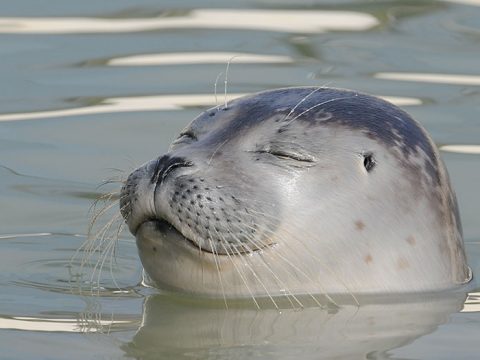
    The Danish and Norwegian standing rigging fisheries for larger fish species (cod, turbot, salmon) claim many victims among the marine mammals. An estimated 7000 porpoises drown yearly in the North Sea in these nets. Another example is the massive death among the harp seals in 1987 along the Norwegian coast. That year, these animals migrated in massive numbers from the Barentsz Sea to more southern regions. In their search for richer fishing grounds, 60,000 animals drowned in the nets of the Norwegian coastal fishermen.