Content on this page requires a newer version of Adobe Flash Player.

Get Adobe Flash player


Search in the Encyclopedia

Dieren en planten

Mens en Milieu

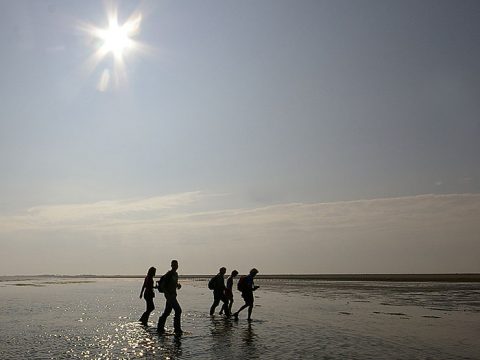
Sunset, Foto Fitis, www.fotofitis.nl

The greenhouse effect

In a greenhouse, the glass retains the warmth from the sun. Similarly, a transparent 'blanket' of materials in the earth's atmosphere, water vapor in particular, does the same by retaining the heat produced by the sun. The term 'greenhouse effect' refers to the rise in the average temperature on earth due to an increased amount of materials in the atmosphere. For the marine and coastal environment, the intensified greenhouse effect is of immediate importance since it can greatly influence sea-level rise. In addition, scientists expect that the greenhouse effect will cause changes in ecosystems.

  • Greenhouse gasses

    The most important material in this case is carbon dioxide (CO2) and methane, . CO2 is released in large amounts when fossil fuels are burned, for instance by industry, traffic and electric power stations. During the 21st century, the Royal Netherlands Meteorological Institute (KNMI) expects a rise in temperature in the Netherlands between 2 and 5 °C, due to the combination of the greenhouse effect and a natural warming up of the earth. Other greenhouse gasses include CfCs (chloro-fluoro-hydrocarbons: a propellant gas found in spray cans), sulfur hexafluoride (SF6), nitrogen oxides, such as laughing gas, NO, NO2 and carbon monoxide (CO). With the exception of CFCs, all of these materials are also found naturally in the atmosphere. Laughing gas, for example, is produced by bacteria. Scientists expect that laughing gas will be the second most common greenhouse gas by 2030.

  • Greenhouse policy

    Various goals to reduce the gasses are not yet effective. An important international agreement to decrease greenhouse gasses is the Kyoto Protocol from 1997, which strives to lower the exhaustion of these gasses by more than 5% between 2008 and 2012, in relation to 1990. However it was only signed by a sufficient number of countries in 2005 to put it into force, and the greatest polluter, the United States, is not among the signatures.

  • Algae and climate

    Many studies are taking place that look at the relationship between algae and the climate. They concern mainly the possibility of phytoplankton to absorb large amounts of the greenhouse gas carbon dioxide (CO2), then embedded in the oceans and thusly removed from the atmosphere. Of course, land plants also take up CO2, but the oceans are much more significant than land for this process. The oceans make up 71% of the earth's surface area and contain algae down to depths of 100 meters.
    Phytoplankton is a heavy consumer of carbon dioxide. It takes in CO2 and processes it into energy-rich organic components, such as sugars, a process called photosynthesis. When the phytoplankton sinks to the bottom, it takes the CO2 with it, embedding it in the sea floor.
    Specifically, the alga Emiliania huxleyi can blossom profusely in the central part of the North Sea. In the North Sea coastal waters, this role is taken over by Phaeocystis globosa. These two species of algae probably contribute a significant amount to the absorption of CO2 in the North Sea area and fighting the warming up of the atmosphere. Blooming Emiliania huxleyi can cover an enormous surface in the North Sea. There are reports of a flowering area measuring more than 100,000 square kilometers. The alga also blossoms for a long time: 3 to 6 weeks. It flowers here almost every year between the end of May and August.

  • Consequences for marine life

    Due to the earth warming up, many plant and animal species presently living in the Atlantic Ocean will migrate to more northern regions. Subtropical animals will shift their territory to the north. Isolated waters such as the Baltic Sea will become less saline due to an increase in the supply of river water.
    British biologists warned in 2007 for an acidifying effect caused by an increased CO2-level in the atmosphere. If the gas should dissolve in seawater, turning the water more acidic, it will be more difficult for calcium carbonate to dissolve. Shellfish need this material for building their shells and therefore will not grow as well with increasing acidification.

  • Greenhouse gasses

    The most important material in this case is carbon dioxide (CO2) and methane, . CO2 is released in large amounts when fossil fuels are burned, for instance by industry, traffic and electric power stations. During the 21st century, the Royal Netherlands Meteorological Institute (KNMI) expects a rise in temperature in the Netherlands between 2 and 5 °C, due to the combination of the greenhouse effect and a natural warming up of the earth. Other greenhouse gasses include CfCs (chloro-fluoro-hydrocarbons: a propellant gas found in spray cans), sulfur hexafluoride (SF6), nitrogen oxides, such as laughing gas, NO, NO2 and carbon monoxide (CO). With the exception of CFCs, all of these materials are also found naturally in the atmosphere. Laughing gas, for example, is produced by bacteria. Scientists expect that laughing gas will be the second most common greenhouse gas by 2030.

  • Greenhouse policy

    Various goals to reduce the gasses are not yet effective. An important international agreement to decrease greenhouse gasses is the Kyoto Protocol from 1997, which strives to lower the exhaustion of these gasses by more than 5% between 2008 and 2012, in relation to 1990. However it was only signed by a sufficient number of countries in 2005 to put it into force, and the greatest polluter, the United States, is not among the signatures.

  • Consequences for marine life

    Due to the earth warming up, many plant and animal species presently living in the Atlantic Ocean will migrate to more northern regions. Subtropical animals will shift their territory to the north. Isolated waters such as the Baltic Sea will become less saline due to an increase in the supply of river water.
    British biologists warned in 2007 for an acidifying effect caused by an increased CO2-level in the atmosphere. If the gas should dissolve in seawater, turning the water more acidic, it will be more difficult for calcium carbonate to dissolve. Shellfish need this material for building their shells and therefore will not grow as well with increasing acidification.

  • Algae and climate

    Many studies are taking place that look at the relationship between algae and the climate. They concern mainly the possibility of phytoplankton to absorb large amounts of the greenhouse gas carbon dioxide (CO2), then embedded in the oceans and thusly removed from the atmosphere. Of course, land plants also take up CO2, but the oceans are much more significant than land for this process. The oceans make up 71% of the earth's surface area and contain algae down to depths of 100 meters.
    Phytoplankton is a heavy consumer of carbon dioxide. It takes in CO2 and processes it into energy-rich organic components, such as sugars, a process called photosynthesis. When the phytoplankton sinks to the bottom, it takes the CO2 with it, embedding it in the sea floor.
    Specifically, the alga Emiliania huxleyi can blossom profusely in the central part of the North Sea. In the North Sea coastal waters, this role is taken over by Phaeocystis globosa. These two species of algae probably contribute a significant amount to the absorption of CO2 in the North Sea area and fighting the warming up of the atmosphere. Blooming Emiliania huxleyi can cover an enormous surface in the North Sea. There are reports of a flowering area measuring more than 100,000 square kilometers. The alga also blossoms for a long time: 3 to 6 weeks. It flowers here almost every year between the end of May and August.