Content on this page requires a newer version of Adobe Flash Player.

Get Adobe Flash player


Search in the Encyclopedia

Dieren en planten

Water en land

Mens en Milieu

Hydrocarbons   Oil   
Oil spill at sea, Marijke de Boer

Oil

Oil is naturally present in small quantities in the sea due to leakage from deeper layers of the earth. In addition, phytoplankton produces oil-like compounds. This accounts for around 1000 tons of oil in the North Sea per year. Estimates of the amount of oil in the North Sea derived from human sources vary from 71,000 to 150,000 tons. More than half of that oil flows from land into the sea via rivers. Discharges from the shipping industry form the second major source of oil pollution. Ships dump 5000 to 13,000 tons of oil annually onto the Dutch continental plate, most of which is illegal.

  • Illegal dumping
    Oil slicks in the North Sea, reported 1998, Ecomare

    Illegal dumping of oil or oil-polluted cleansing water from ships is probably the greatest cause of oil victims among seabirds in the North Sea. Every year, patrol planes and surveillance ships discover between 300 and 500 oil slicks, only in the Dutch section of the North Sea, which is one tenth of the total surface.
    Illegal dumping of oil or oil-contaminated rinse water by ships is the greatest cause of oil victims among the sea birds in the North Sea.
    Every year, surveillance planes and ships discover 300 to 400 oil slicks in the Dutch part of the North Sea, which is only one tenth of the total surface. In most cases, it involves mineral oil. The rest is vegetable oil. The number of mineral oil slicks is slightly declining, while slicks containing vegetable oil is slightly increasing.

  • Burden of oil in the North Sea

    The total load of oil in the North Sea in 1995 was estimated at 150,000 tons. That was 80,000 tons in 1990. The load then originated mostly from shipping (more than 60,000 tons) and input via rivers (67,000 tons). Rivers transport oil originating from inland (water) transportation, households and traffic (via the sewage system). Emission from offshore rose significantly between 1980 and 1990, however declined substantially after 1990 due to the ban on discharging oil-bearing drill cuttings.
    The bottom of the Dutch part of the North Sea contains less oil in most places than the policy's target value. The concentration of oil in the bottom is only too high around drilling platforms and discharge areas. Because oil-bearing cuttings are no longer allowed to be dumped, the situation in the bottom will no longer degrade.

  • Oil disasters in the North Sea

    In recent times, accidents with oil tankers or drilling platforms rarely happen anymore in the North Sea. The most recent large oil disaster dates from January 1993, when the oil tanker Braer broke apart by the Shetland Islands. The tanker lost 85,000 tons of oil. Due to the stormy weather, the damage to the environment was not as bad as expected. The released oil spread out quickly and caused the deaths of 1500 shags, guillemots and long-tailed ducks.
    In 1988, while only 300 tons of oil ended up in the sea due to a leakage in the tanker Borcea in front of the coast of Zeeland, 10,000 birds died along the Dutch coastal zone.

  • Oil in the marine environment

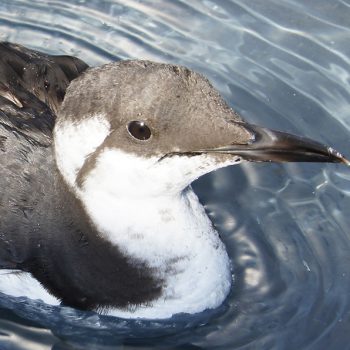
    Oil is a mixture of soluble and insoluble materials. The insoluble materials in oil can form a floating layer in water, which can besmear marine animals. In the Dutch section of the North Sea, around 40,000 birds die from oil pollution every year. Besides seabirds such as guillemots, wading birds including eiders are also victims of oil pollution.
    The soluble materials from oil are often poisonous. Some parts of these materials are easily degraded or volatile and therefore cannot accumulate in the food chain. However, victims can fall locally. The poorly degradable materials can accumulate in the food chains and in the sediment. The effects of these materials are usually apparent high up in the total ecosystem of an area. The dynamic balance of such a system can be disrupted for many years by an oil disaster.
    The disturbances in the biotic community of the tidal zone, caused by the Torrey Canyon disaster lasted a very long time: the old situation only returned in most places after 10 years.
    At any rate, oil by fish is not advisable. Fish eggs in particular are sensitive to oil spills and disasters. It is known that eggs from cod, herring and plaice will not hatch when in contact with even just small amounts of oil, or if they do then the larvae are deformed. The larvae usually die within 24 hours after hatching.

  • Oil on the flats

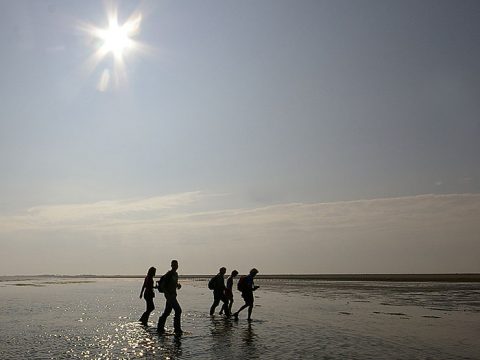
    Experts predict the chance of an extensive oil disaster taking place in the Wadden Sea at one in 50 years. Oil slicks can wash up on the sandbanks in the Wadden Sea, where a large section of the bottom lies exposed during low tide. Before the benthic animals suffocate in the oil, they carry the into the oxygen-depleted bottom oil through their digging activities. The oil then becomes impossible to remove. Bacteria in the bottom will break down the oil, however due to a lack of oxygen, that can take a very long time. If an unexpected oil disaster should occur in the Wadden Sea, it is very important to remove the oil from the bottom as quickly as possible through mechanical means. When an amount of 10 ml oil ends up on one square meter of tidal flat, effects on the life can already be detected.
    Luckily, the Wadden Sea has been spared a real oil spill. However, the opportunity is certainly present: the passing ships in the shipping lanes to the north of the islands together transport an average of around 200,000 tons of oil per day. On the Wadden Sea, around 250,000 tons of oil are transported yearly to supply the islands.

  • Effects on coastal vegetation

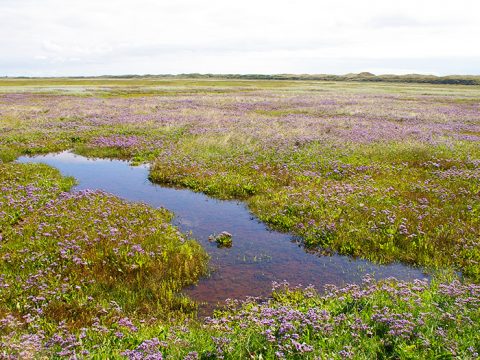
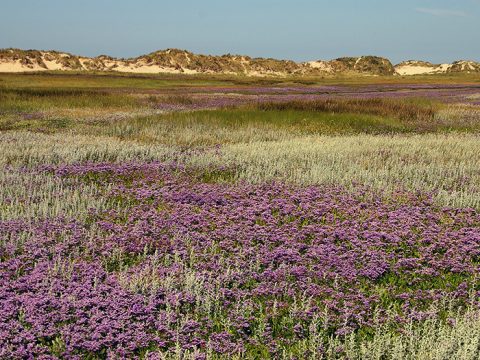
    Large oil disasters can be disasterous especially for seaweed and salt marsh plants: the plant parts growing above ground die off; in the most favourable situation, vegetation of rocky coasts and marshes recover after 1 to 2 years. Disasters outside of the North Sea region, with the tankers Torrey Canyou (1967, off the coast of Cornwall) and Amoco Cadiz (1978, off the coast of Brittany), have shown just how great the damage can be. Annual salt marsh plants such as salicorn and annual seablite recover less quickly from an oil disaster than perennial species. That is why there is a different vegetation after an oil disaster.

  • Combatting the oil
    Oil-combat ship the Arca, Coastwarch, Royal Dutch Navy

    Oil pollution can be dealt with in two ways. It can be handled with chemicals which help the oil particles to disperse in the water or it can be swept up: mechanical removal.
    The nature and extent of the damage will strongly depend upon the way in which an oil disaster is approached. By allowing the oil to float on the surface until it breaks itself up, damage occurs among the birds, fish larvae and fish eggs as well as the tidal zone if the oil reaches the coast. Chemical dispersal can prevent this, however can also produce high concentrations of oil locally in the water phase of stagnant water basins, causing damage to fish and other organisms.
    Mechanical removal is then the preferable choice. In those cases where the wave height or the extent of the disaster makes this impossible, then the dispersal option must be applied. In these cases, the ecological aspects must also be taken into account.
    Small oil slicks are difficult to combat. Usually, such a slick thins out and evaporates by itself before an oil combat ship is present at the disaster area.
    The Netherlands has a number of special oil-combatting vessels, including the newest to the Coastwatch fleet in 2000, the Arca. In addition, dredging vessels with sweeping arms are also employed. Other aids are available for removing oil from the beaches, marshes and other kinds of coasts. Containers with material for removing oil by hand have been placed at various spots along the coast, including the Wadden Islands. One such container has enough material for 50 to 100 people to clean up the oil spill.
    Rijkswaterstaat (RWS) assumes that a large oil disaster (77,000 tons of oil) could happen once every 100 years. According to RWS, it is too expensive to maintain sufficient cleaning capacity for such a disaster. There is presently a capacity of 15,000 tons for the Dutch part of the North Sea and even less for the Wadden Sea and Westerschelde.
    A kind of jelly has been made in England that absorbs oil. A polluted beach can be treated by smearing it in with the jelly and allowing it to soak up the oil. After the oil has been absorbed by the substance, it can be rolled up like a mat and removed for processing.