Content on this page requires a newer version of Adobe Flash Player.

Get Adobe Flash player


Search in the Encyclopedia

Dieren en planten

Water en land

Mens en Milieu

Pollution   PCBs and BDEs   
Plastic toy made with colouring and softening agents , Photo www.tapirback.com

PCBs and BDEs

PCB stands for polychlorinated biphenyl. BDE stands for polybrominated diphenyl ether (modified PCBs) They are collective terms for large groups of materials that are difficult to decompose. BDEs are used as softeners in many kinds of plastic and as a flame retardant in such objects as dashboards, curtains and Christmas decorations. PCBs and BDEs are very damaging for the environment. Production and applications using PCBs have been forbidden in the Netherlands since 1985, however the material has not disappeared from the environment.

  • Effects
    Average level of the seven most important PCBs, Ecomare

    Leaky apparatus and instuments in garbage dumps used to be an important source of PCB pollution in the Netherlands. Many PCBs were also released during uncontrolled combustion of chloride-holding synthetic materials, such as sewer and electric pipes.

    Since it became known around 1975 that PCBs had very damaging effects in nature, attempts have been made to reduce the discharges. Supervised processing of PCB-holding rubbish in particular received much attention. The graph above shows how terribly persistent PCBs are: the levels of PCBs which are attached to particles in the marine environment are only declining very slightly if at all.

  • Sources

    PCBs have been applied in the industry and technique for more than 50 years now. Its usage can be divided into two categories: open and closed systems. According to the PCB agreement of May 12 1979, its application in open systems has been forbidden in the Netherlands, as well as in the other countries of the EU. In a number of the former Eastern bloc countries, such as Czechoslovakia, one has proceeded much longer with the production and usage of PCBs. Some examples of usage in open systems are insecticides and in softeners in polyester materials, paints, ink, varnish and glue. Some examples of closed systems are PCBs in transformers and condensers.

  • Behaviour in the environment

    In the environment, PCBs attach themselves to the ground and mud. Degradability occurs very slowly, especially when the chloride content is high.

  • Toxicity

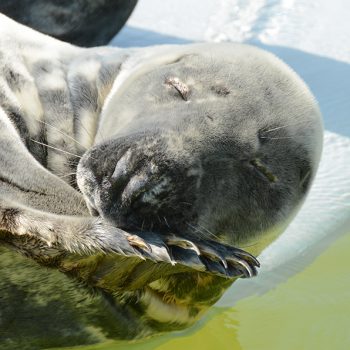
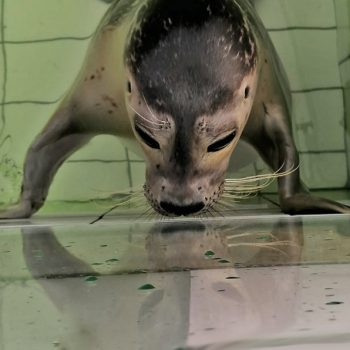
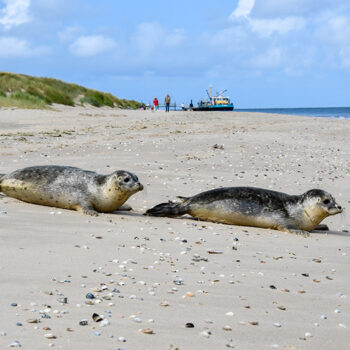
    Sludge-eaters (such as lugworms and rag-worms) consume PCBs. Because PCBs dissolve easily in fats, they readily accumulate in the natural food chains: from the lugworm to the flatfish and on to the fish consumer, where the concentration of PCBs continues to accumulate in the fatty tissue. In this way, seals could become so contaminated by PCBs that dead specimen had to be handled as chemical waste. PCBs are poisonous for just about all types of animals. The most obvious effect is the decrease in the fertility of the animal since PCBs have a disturbing effect on the hormonal constitution.
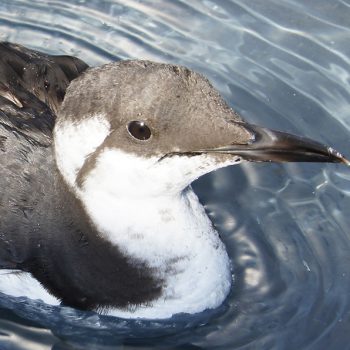
    PCBs are found in many fish, birds and mammals. In 1980, the Dutch eel fishermen were stricken with a sale embargo. Because the eel from the river basin of the Rijn appeared to contain so many PCBs, there was direct danger for the public health. Since around the year 1997, (too) many PCBs have been measured in the eel from the Haringvliet and the Hollands Diep, although not in amounts that are dangerous for human health.
    Researchers discovered in 1998 that a number of female polar bears on Spitsbergen appear to have a penis-shaped growth. It was also found that polar bears in this region contained six times as many PCBs in their blood than Canadian polar bears. Researchers suspect that the PCBs affect the bear's hormonal constitution.