Content on this page requires a newer version of Adobe Flash Player.

Get Adobe Flash player


Predictions of rising of the sea level, Ecomare

Sea level rise

Since the beginning of the 20th century, global sea level has risen an average of 15 centimeters . The warming up of the earth causes the seawater to expand and land glaciers to melt, resulting in sea level rising. In addition, the northern and western part of the Netherlands is in a continual stage of sinking due to the tilting of the continental plate upon which the country rests. Worldwide, experts expect the sea level to rise a maximum of 59 cenitmeters in the 21st century, while the western and northern Netherlands will sink around ten centimeters.

  • Expanding and melting

    Sea level rise and fall have been going on for millions of years. Even during ice-free periods millions of years ago, there is evidence that the sea level rose up to 70 meters higher than was average due to ocean water warming up.
    During the last ice age around 10,000 years ago, a large part of the North Sea dried up. When the climate started warming up, the land ice melted and the sea level rose 120 to 140 meters. This rise happened very quickly at first. Later on, the speed gradually decreased. In general, the sea level has continued to rise little by little over the past 1000 years. Only during the late Middle Ages (a small ice age) did the sea level drop. Since around 1850, the average temperature has again increased, the glaciers have grown smaller and the sea level along the Dutch coast, for example, has risen 20 to 30 centimeters. It has once again reached the level during the early Middle Ages.
    From measurements taken over the past 150 years, there seems to have been a constant rising of 20 centimeters per century. Due to the increase in the amount of carbon dioxide and other 'greenhouse gasses' in the atmosphere, the average temperature on earth can increase even further. The climate panel of the United Nations, IPCC, estimates the sea level to rise around 59 centimeters in the 21st century particularly due to warmer water expanding. The most unfavourable scenarios reckon with 85 to 130 centimeters per century. Depending upon eventual local climate changes, new parts of the ice caps and glaciers in the high mountain areas will also start to melt. These two processes could lead to a substantial rise in the sea level.

  • The Netherlands is tilting
    The tilting of the continental plate, Ecomare

    The distance between sea level and the sea bottom along the Dutch coast is not only increasing from the rise in sea-level, but also from the subsiding sea bed. Rijkswaterstaat expects the bottom in the low-lying northwestern part of the Netherlands to have declined between 2 to 60 centimeters in 2050, while the southeastern part will have risen several centimeters. This means that the Netherlands is slowly but surely toppling in the direction of the North Sea. This natural bottom movement has been uniform in nature throughout the 20th century.

  • General consequences for the islands and the coast

    The islands in the Pacific Ocean, as well as low-lying countries on various continents such as Bangladesh, are being threatened by a rising sea level.
    The dikes in the Netherlands will need to be raised again and there is uncertainty as to whether the rows of dunes will suffice in holding by the sea. According to calculations made by Rijkswaterstaat, adaptions for a sea level rise of one meter will cost 4.5 to 5.5 billion euros. The Delta Works in the 1970-1980s cost around 6.8 billion euros.

  • Effects on the Wadden Sea

    The sandbanks and mud flats form an important chain in the ecosystem of the Wadden Sea. Lots of birds of the tidal flats capture their prey on the dry banks during low tide. One low-tide period does not appear to be sufficient for the necessary daily allowance, so that the birds must also search for food during a second daily low-tide period. Flooded tidal flats means a shorter foraging period. In reality, it appears that there are great differences in the food supply between the mud flats. Not all flats are interesting for every bird. The flats with the greatest amount of benthic life attract the most birds. The total biomass of the benthic life on growing mud flats is greater than on flats just as large yet eroding. Young brood from shellfish do not survive as long on the latter sort.

  • The sand appetite of the Wadden Sea

    If a hollowing occurs in a section of the tidal basin of the Wadden Sea, the balance is restored by the transportation of sediment from another section of the system. If the sea level rises, or the tidal basin subsides due to gas or sand exploitation, then silting up will also be excelerated. This so-called 'sand appetite' of the Wadden Sea is particularly appeased with sand from the North Sea coast of Texel and North Holland. Sand is disappearing here and relocating in the more easterly lying wadden region.
    In that way, enough sand remains in the wadden region to keep up with the normal rise in the sea level, with the exception of two places in the Dutch section. At the two ends of the Wadden Sea, the Marsdiep in the west and the Eems-Dollard in the east, more sand and mud will disappear than precipitate.
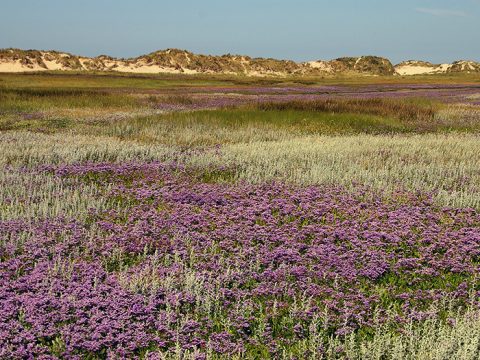
    The existing salt marshes along the Frisian and Groningen coast are not in danger at the moment. The present growth of the marshes along the mainland is equivalent to 130 to 180 centimeters per century. The marshes on the south side of the Wadden Islands are growing 30 to 80 centimeters per century. If sea-level rise occurs simultaneously with more wind and higher waves, these marshes could flood.
    Should the sand appetite in the Wadden Sea increase due to gas, sand and shell exploitation, it will eventually result in extra erosion of the island shores. This extra erosion will add an additional amount to the sand demand being caused by sea-level rise.
    Should the sea rise 60 centimeters per century, then together with the extra sand appetite, the wadden coast will erode more quickly – an estimated one to two meters more per year. Should the sea level rise 85 centimeters per century, then the estimate will be 2 to 3 meters extra per year. There will also be a major increase in the need for additional sand nourishments.
    The RIKZ concluded that the Wadden Sea is capable of staying balanced with a 20 to 60 centimeter sea-level rise. Banks and marshes in general will not be permanently under water. It will become a problem when it rises 85 centimeter or more, accompanied by a strong wind. In that case, the dry lying sandbanks in the Wadden Sea will eventually disappear permanently (in around a century).