Content on this page requires a newer version of Adobe Flash Player.

Get Adobe Flash player


Search in the Encyclopedia

Water en land

Mens en Milieu

Ecomare   Seal Sanctuary Ecomare   
Ecomare, Photo Sytske Dijksen, Ecomare

Seal Sanctuary Ecomare

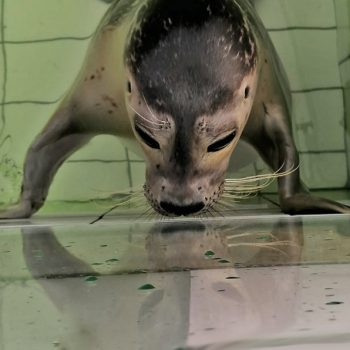
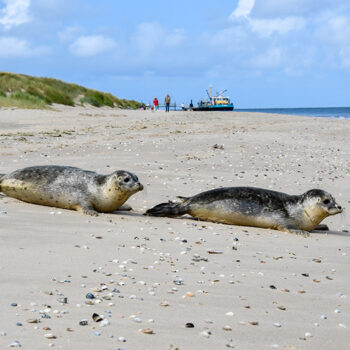
Ecomare is the regional hospital for seals in need that are found in North Holland. In the summer, when the ferry service between Texel and Vlieland is active, seals stranded on Vlieland are also treated at Ecomare. Seals have been cared for on Texel in since 1952. In the beginning, all of the captured animals were kept at the former Texels Museum. Returning them to the sea was irresponsible since seals were being actively hunted. However nowadays, the staff at Ecomare returns around 30 seals yearly to the Wadden Sea.

  • The beginning of the seal sanctuary
    Mr and Mrs de Haan: pioneers of seal rehabilitation, Ecomare

    In 1952 Mr. de Haan, the former director of the Texels Museum, and his wife Annie began taking in abandoned young seals (new-born pups which have lost their mothers) and sick seals which were found either on the beaches of Texel or elsewhere along the coast. Through trial and error, they eventually succeeded in keeping the seals alive and nursing them back to health. They were not returned to the sea due to the active seal hunt in those days.
    The deteriorating seal stock in the 1950s made the work at the sanctuary very important. On the one hand, seals which would have surely died were being saved, and on the other hand, the public visiting the Texels Museum was being exposed to the problems in the Wadden Sea via these seals.

  • Caring, breeding and releasing
    Releasing seals in the reservation south of Vlieland., Ecomare

    In the course of the years, the relationship towards the seals changed considerably. Hunting seals ended in the Netherlands. Seals that were cared for could be returned to the Wadden Sea as soon as they were healthy.
    For the rather large group of seals which had been in captivity for so many years, the solution was not that easy. The average age in the group is now around 30 years, which meant twice as old as their companions in the Wadden Sea! Some are blind or missing teeth and molars. These animals are so accustomed to their life in captivity that it would take a great effort to re-adjust to the wild.

  • Adopting seals at Ecomare
    , Ecomare

    The seal adoption program at Ecomare started in 1990. Whoever adopts an animal, receives a color photo of the seal and an information kit. The number of adoption parents in 2010 rose to 10,000 individuals and organizations.

  • The birth of a harbour seal
    Birth of a harbour seal, 1994, Ecomare

    In 1994, Ecomare's photographer, Salko de Wolf, witnessed the birth of a harbour seal.

  • A fellow-center in Groningen

    In addition to the center on Texel, a second seal sanctuary, the crèche in Pieterburen, began in the early 1970s. The amount of stranded pups and sick seals was actually decreasing on Texel at that time, one reason being the number of seals in the western section of the Wadden Sea had diminished more than in the eastern section. The seal population in the western Wadden Sea slowly increased in the 1980s, whereby the rehabilitation function, along with the breeding function, once again became an important task for the center on Texel. In 1988, after the outbreak of the deadly epidemic virus, both crèches fulfilled an important role for the researchers searching for the causes of this disease.

  • Fellow centers (international)
    , Sandra Niën/Jaco Spek

    There are two seal sanctuaries in Germany: in Norden-Norddeich and in Friedrichskoog. The sanctuary in Norden-Norddeich takes in between twenty and fifty marine mammals, including cetaceans, per year. In Denmark, the Fiskeri- og Süfartsmuseet in Esbjerg is equipped for taking care of seals, although it only does that for scientific studies. Stranded seals in Denmark are killed or sold to a zoo, since the Danish feel that man should not interfer in natural selection.
    A seal sanctuary was started in 1998 in the Belgium town of Blankenberge, at the Sea Life Center.

  • The ambassadors of the Wadden Sea
    Public interest during a feeding at Ecomare., Ecomare

    At Ecomare, the seals fulfill an important role as ambassadors of the Wadden Sea. The story of the seals, told during feeding times and displayed in the exposition both inside and outside, is related to the causes of the problems in the Wadden Sea.

  • The future of seal rehabilitation in the Netherlands
    Young grey seal on the beach, Texel 1992., Ecomare

    Every time the seals in the wadden region seem to be doing well, debates flare up as to whether or not it is still necessary to help seals in need. In 2002, the final report of the Scientific Platform for Seals Wadden Sea was presented. This report, written by all the involved ministries, scientists, seal sanctuaries and nature conservationists, concluded that "in order to preserve the seal population, it is not necessary to remove, care for and return sick, weakened or deserted seals to the Wadden Sea. It is not really necessary to care for wild seals."

    Peter Reijnders, seal expert from IMARES finds the new ruling very logical. The risk of releasing human-cared seals is that weakened specimen can spread new diseases. As far as IMARES is concerned, the seals should not receive any medicine. 'All that doctoring is bad for the population in general', according to Han Lindeboom from IMARES.

    However for Ecomare, there are still two reasons for continuing with the rescuing and caring of seals. From the point of view of pure animal protection, every animal that can be saved is meaningful, all the more so since it appears that once returned to the sea, it survives well in the wild. However, what is even more important, through the caring of the seals many more people are reached. Using only some cute pictures does not work nearly as well. Every year, the story of the seal and the Wadden Sea is told to more than a quarter million visitors, and via its information, to thousands of others. In that way, Ecomare makes a huge contribution in combatting the causes of the problems in the Wadden Sea.

Back home