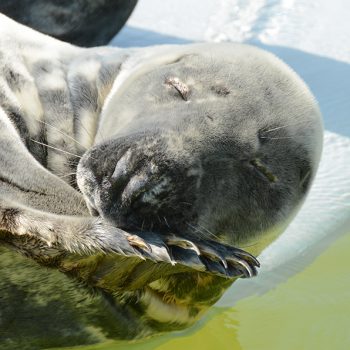
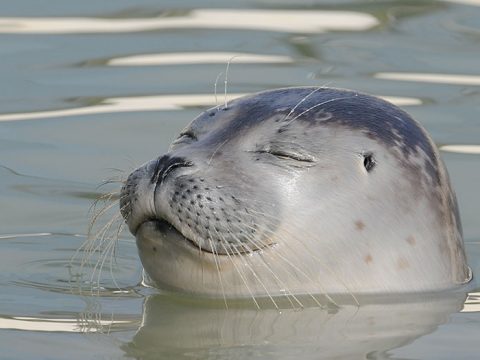
Seals and whales are mammals. They are warm-blooded, they breath with the help of lungs and they deliver live births. The forefathers for all marine mammals were land animals. In the course of millions of years, they spent more and more time in the water, and adapted themselves to an aquatic life in all kinds of ways. Whales and dolphins are no longer able to live out of water. They need the upward force of the water to support their bodies, and even their young are born under water. Seals, on the contrary, go on land to give birth and nurse.
Just like fish, marine mammals have a streamlined body in order to swim well. The head is rounded and the protruding earlobes have disappeared. The front paws have been modified into paddle-like flippers. The seal's hind limbs have also been re-formed into flat flippers. By dolphins and whales, the hind legs are totally absent. The tail fin of whales is not an extension of the tail bone. It is a separately formed body part.
Because of their very thick layer of fat, marine mammals are able to keep warm in the cold water. This fat can also be used as an energy source during times of food scarcity. Seals have a remarkable manner for retaining warmth in places where the fat layers do not exist, for example, in the flippers: the arteries which bring the blood to the flippers are closely entangled with the arteries which return the blood from the flippers to the body. The blood flowing in releases a large part of its warmth into the blood returning from the flippers and thereby limits its heat loss. To prevent overheating in the summer, the flippers are then used for discharging warmth.
The seals have hair to prevent dehydration and damage to their skin when above water. Dolphins and whales have, and need, no hair since they always stay under water.
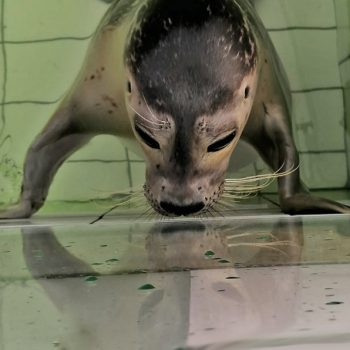
The eyes of marine mammals are poorly developed. Whales make use of sound waves to find their way about under water. Therefore, they are incredibly sensitive to noise interference below the sea surface. Seals have long, sensitive whiskers.
Scientists have discovered that marine mammals do not actively swim in order to dive to deep depths. Images from videa cameras attached to the back of various species of seals, whales and dolphins show that the animals only swim at the beginning of the dive. They trust gravity to do the rest and slowly glide down to the bottom. Because they use less energy in this way, they are able to stay longer under water.