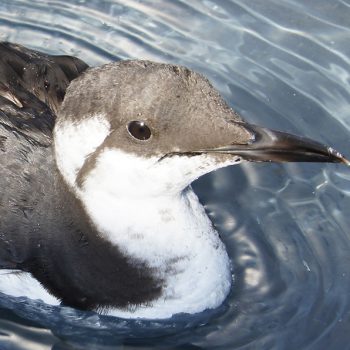
Seabirds and marine mammals drown regularly in the nets of the standing rigging fisheries. By the Norwegian coast, it has been established that around 30,000 guillemots die in fish nets per year.
In the 1980s, an end seemed in sight for the growth of the seabird population in the North Sea due to the arrival of the industrial fisheries. This sector catches small fish such as lesser sandeel and sprat, which is food for many of these birds. The catch is ground to fishmeal and used to feed livestock, in fish farms, in cans and dry-food for cats and dogs and even as fertilizer. Before 1950, this form of fisheries on the North Sea was more or less unknown, but grew in the 1970s to a yield of two million tons of fish per year (compared to one million ton of fish for human consumption). Lots of industrial fish come from Danish and Norwegian fishermen, which make frequent use of giant ring nets in the North Sea. In addition to lesser sandeel and sprat, lots of young herring are caught.
The first consequences of all that fishing are already apparent. On the Lofoten, a group of islands off the Norwegian coast situated at the very most northeastern part of the North Sea, only one out every thousands of parent pairs of puffins were able to bring up their young in the early 1990s. Lesser sandeel and young herring is food for juvenile puffins, and that had disappeared. The puffin population of the Lofoten grew old. Younger generations were lacking. Guillemots and kittiwakes found themselves in the same situation.
Such problems also began elsewhere in the North Sea. After 1982, the lesser sandeel around the Shetland Islands declined in number. There were a lot of fishing activities taking place around this group of islands: from 1974 to 1982, the yields of lesser sandeel grew extremely rapidly from 8,000 to 52,000 tons per year. Since 1983, the Arctic terns in particular, but also the Arctic skuas, kittiwakes, puffins and fulmars had poorer nesting results due to the food shortage. In 1988 and 1989, the colonies of the great and Arctic skuas, the fulmar and the kittiwake did not produce even one young. The number of Arctic terns had declined by 70%.
It cannot be proven from the above figures that the fisheries are the direct cause of the problem. It is possible that the problems by the Lofoten and Shetland Islands was caused by a change in the current pattern of the water. Changes in the direction of the current, salinity or temperature can have a major influence on fish stock. However, one can set major question marks as to why the situation deteriorated so badly for the seabirds.
There are even more signals in which it appears that the birds in the North Sea have problems finding sufficient food during the nesting season as well as in the winter. The numbers of dead guillemots, auks and kittiwakes which washed ashore increased in the Netherlands during the winters in the 1980s, partially due to starvation, partially due to chronic (oil) pollution and partially because more birds overwinter in the southern North Sea. There seemed to be a slight improvement during the 1990s, as far as oil victims were concerned.