The former Directorate General Shipping and Maritime Affairs (DSGM, now DGG: Directorate General for Transport of Merchandise) from the Ministry of Transportation and Public Works wished to know to what extent was monitoring oil victims a useful expedient for measuring the effectiveness of the Environmental Policy Plan to decrease the oil discharges at sea by ships. The counts that were used before this study began in 1985. The study was performed by the Netherlands Seabird Group, under the title "Beached bird survey".
The percentage of birds smeared in oil found along the Dutch coast in the winters of 1986-1998 had decreased among all the species compared to the period 1969-1985. This decrease is considered to be a sign that the risk of coming in contact with oil has declined for these animals. Kees Camphuysen carried out the project "Beached bird Survey" for the Dutch Seabird Working Group, a study commissioned by the Ministry of Public Works. According to him, the number of 'oiled birds' found is still high when compared to the surrounding North Sea countries.
Almost three fourths of the recognized oil contamination appeared to be discharges of oil mixtures. Raw oil from tankers or oil platforms is rarely found along the Dutch coast.
There was a decrease found in all of the studied species and groups of coastal birds and seabirds. Assuming that the habits of the birds has not essentially changed and that their distribution at sea has also remained more or less the same, the Seabird Group concluded that the amount of oil at sea is the determining factor for the chance of coming into contact with oil.
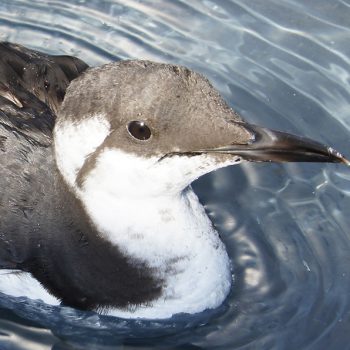
The researchers make a distinction between three groups of birds. One group consists of birds which inhabit the coastal waters: divers, grebes and scoters. The second group consists of waterfowl, grallatorial birds and Larus gulls, and the third group contains the real seabirds: the fulmar, the kittiwake, the auk and the guillemot. When the percentage of oil pollution is seen as the chance that a bird ends up dead or alive in the oil, and if this chance is determined by the amount of oil at sea (number of slicks, surface oil of tons of discharged oil), then the decline in the oil pollution percentage is directly parallel to the decline in oil pollution. With the proposed assumptions, it can be concluded that the oil pollution has decreased by at least 20% since 1986, according to the bird researchers.
It has now been proposed to make a more direct connection between the information concerning birds stranding, shipping accidents and the prevention of oil slicks. In the near future, it should also be attuned to an international relationship so that the counting results from all of the North Sea countries can be directly and regularly compared. It will then be possible to keep a constant watch on the situation in the various sections of the North Sea.