Content on this page requires a newer version of Adobe Flash Player.

Get Adobe Flash player


Search in the Encyclopedia

Puffin

size:

length: 26-29 centimeters
wingspan: 47-63 centimeters

weight:

400 grams

color:

black/white with notable beak; orange legs

age:

maximum 34 years

food:

mostly fish, sometimes crustaceans

movement:

flying and swimming, not handy walkers

enemies:

oil spills in sea

reproduction:

maturity: 5 years
number of eggs per nest: 1

  • Dut: Papegaaiduiker
  • Eng: Common or Atlantic Puffin
  • Fren: Macareux moine
  • Ger: Papageitaucher
  • Ital: Pulcinella di mare
  • Dan: Søpapegøje (Lunde)
  • Nor: Lunde
  • Fries: Sépappegaei
  • Lat: Fratercula arctica
Puffin, Jeroen Reneerkens

Puffin

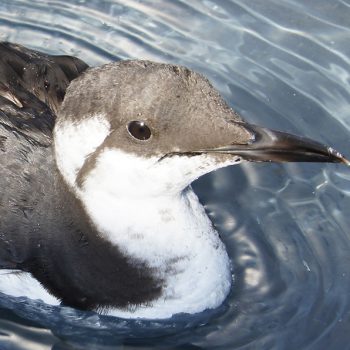
The clowns among the seabirds, that's what the puffin is often called. That's because of their large colorful beak. They only have this fancy forebeak during breeding season. During the winter, the forebeak is gone, leaving behind a short dark bill. Besides this aspect, puffins don't resemble clowns in any way. Clowns are clumsy but puffins are very handy. For example, they can hold lots of slippery fish in their beak at one time, sometimes as much as 10! You see them hanging out of the sides of the mouth while trying to catch just one more. Their secret to this trick has to do with their barbed palate. The bird uses its tongue to push the fish against the barbs.

  • Spotted in the North Sea
    Puffin, Marijke de Boer
  • Distribution and habitat
    Distribution of puffins, Ecomare
    Source: important bird areas for s

    Puffins nest in burrows often dug by themselves located on the upper edge of cliffs or small islands. In the winter, the birds migrate south to avoid the freezing cold. Contrary to earlier beliefs, the migration route for puffins is not determined through genes. The birds all follow different routes. They probably learn the route when they are young and have the time to properly explore their surroundings. For migration, they choose a route which takes them along the areas with the most food in the sea.

  • Tasty dish

    Puffins are consumed in Northern Europe. They are caught with a kind of butterfly net. Tourists don't generally like puffin meat because it tastes like cod-liver oil.

  • Aging population

    On the Lofoten, a group of islands off of the Norwegian coast, only one out of every thousand pairs of puffins have succeeded in raising their young. The juvenile puffins eat lesser sandeel and young herring which have become scarce due to industrial fisheries. The puffin population on the Lofoten is aging.