Content on this page requires a newer version of Adobe Flash Player.

Get Adobe Flash player


Search in the Encyclopedia

Kittiwake

size:

length: 39 centimeters
wingspan: 108 centimeters

weight:

410 grams

color:

white, with blue-gray back and wings, black legs and yellow beak

age:

maximum: 28 years

food:

fish and other marine animals

movement:

fly, walk, swim

reproduction:

incubation: 25-32 days
generally 2 eggs per nest

  • Dut: Drieteenmeeuw
  • Eng: Kittiwake
  • Fren: Mouette tridactyle
  • Ger: Dreizehenmöwe
  • Dan: Ride
  • Nor: Krykkje
  • Fries: Winterkob
  • Ital: Gabbiano tridattilo
  • Lat: Rissa tridactyla
Kittiwake, Marijke de Boer

Kittiwake

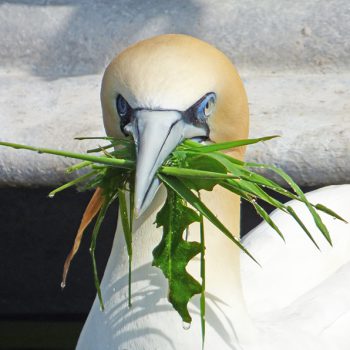
Kittiwakes are true seabirds. They spend practically their entire life at sea. They only land on the coast to breed and make their nests on the steep cliffs of Helgoland, England, Scotland and Scandinavia. Since 2000, kittiwakes have also been breeding in Dutch territory, on drilling platforms at sea. Being at sea so much, they eat mostly fish, which they capture by hanging just above the water surface. They dive into the water as soon as they sight something that looks tasty. It's not difficult to make a mistake. When a kittiwake is found on the beach, it is usually a victim of marine litter, having mistaken it for something edible. Another common cause of death is an oil spill, which covers the bird as it dives into the water.

  • Nesting on ridges
    Kittiwake (Farne Islands), Foto Fitis, www.fotofitis.nl

    Kittiwakes nest in colonies on rocky coasts: they build their nests from seaweed on very narrow ridges, using mud to glue them to the rocks. The eggs have a predominant cone shaped. This is extremely important, so that they roll back to the middle of the nest and not to the edge or over the edge of the ridge.

  • Distribution
    Distribution of kittiwakes, Ecomare
    Source: important bird areas for seabirds in the North Sea

    During the winter, around 75,000 kittiwakes can be found in the Dutch section of the North Sea. In 2006, 40 nests were found on three Dutch oil platforms, of which 32 were on one platform alone.

  • Spotted in the North Sea
    Kittiwakes, Marijke de Boer

    Kittiwakes are the only gulls found regularly in large numbers in open sea.