Content on this page requires a newer version of Adobe Flash Player.

Get Adobe Flash player


Search in the Encyclopedia
  • Dut: Zeehonden
  • Lat: Phocidae
  • Eng: True seals, earless seals
  • Ger: Hundsrobben

Seals

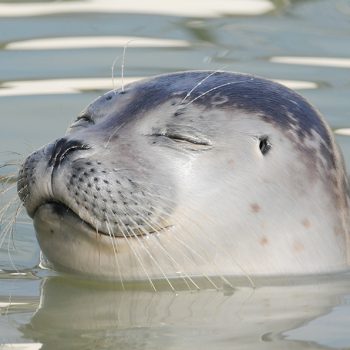
Seals are the acrobats of the sea, but they are very clumsy on land. A seal easily races through the water at 35 kilometers per hour, while it is lucky to cover 2 kilometers per hour on land. With its cute, round eyes, seals see very well under water. However, they would need eyeglasses to see sharply above water. Seals are completely adapted to life under water. Nevertheless, you can spot them regularly on the surface. They like to lie in the sun while resting on a sandbar or beach.

  • A seal's diet
    Grijze zeehond eet platvis, Salko de Wolf

    Seals primarily eat fish. They use their whiskers for locating prey in these predominantly turbid waters. Seals can feel the slightest movements in the water, such as displacement caused by a swimming fish. They can determine where the fish is swimming and snatch it with their sharp teeth. Seals do not have a preference for one specific fish species, but they usually catch fish that live close to the sea bottom. Flatfish, lesser sandeel and cod species are their favorite food, although what they eat can vary per season, depending upon what's available.

  • In the water
    Swimming motions of a harbour seal, Drawing from a Danish school worksheet

    A seal swims just as readily on its back as on its belly, standing upright or upside down. The front flippers serve as paddles; the body and hind fins provide the propulsion.
    Seals can dive down to depths of hundreds of meters. During the first few minutes, they swim actively downwards, after which they go into a kind of gliding flight while they sink even deeper. Their body is totally adapted to long and deep dives. Their blood can absorb much more oxygen than human blood. Furthermore, they can lower their heart rate tremendously during the dive, from 40 to less than 1 beat per minute. This means they don't need to breathe as often. When they ascend from deep depths, they can pump out the inhaled air from the air sacs, preventing deadly nitrogen bubbles from entering the bloodstream. Once above water, the heart beat of a seal increases to 120 beats per minute in order to provide oxygen for the organs.

  • On land

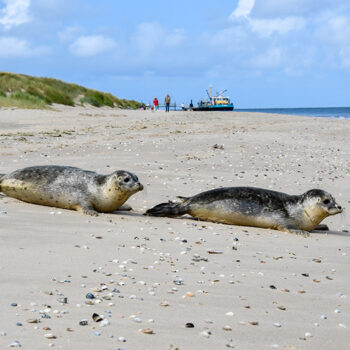
    A seal is perfectly adapted for life in the sea, but is clumsy on land: it cannot walk since its hind fins lie in extension of its body. Sea lions, on the contrary, can use their back fins more or less as 'hind feet'. That is why they can walk much better than seals. Seals drag their body over the ground with the help of their front flippers, a movement referred to as hobbling.

  • How do seals sleep?
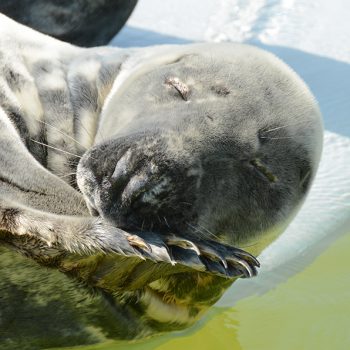
    Sleeping seals, Ecomare

    Seals sleep in the water as well as on land. In the water, they sleep floating in a standing position, like a fishing bobber, or floating horizontally on the surface. Because they are sleeping and not actively swimming, they can stay under water much longer than when hunting for food. There are known incidents where seals stay under water up to half an hour, however on the average, their stay is not longer than fifteen minutes.

  • Seal anatomy
    Anatomy of the seal, Drawing by M. Oberendorff
  • Distribution and counts
    Seals from the air, Ecomare

    The number of seals in the Wadden Sea region is well documented. Scientists from IMARES count the seals in the Dutch Wadden Sea from an airplane by taking photos of them while lying on the sandbanks. One third of the population is then under water, so the scientists add 30% to the total counted in order to reach a final estimation.

    Of the seals that inhabit the international wadden region (Netherlands, Germany and Denmark), the large majority are harbour seals, numbering around 35,000 in 2011 (adults and pups). However, harbour seals also inhabit other waters. In the North Sea area, they are found around the Scottish islands, in the Wash, along the English, French and Belgium coasts, in the Danish Skagerrak and along the southern coast of Norway.

    Grey seals are found primarily around the Scottish islands, along the British east coast and in Cornwall. In December 1999, there was even a young seal seen in the Thames beyond London. In the Dutch Wadden Sea, a colony of grey seals was established in the 1990s. Since then, it has expanded into the largest colony in the entire Wadden Sea. In the Dutch Wadden Sea alone, a total of 2388 grey seals were counted in 2011. The largest groups are located west of Terschelling, but small groups or individuals are sometimes seen elsewhere. The German islands of Helgoland and Amrum have colonies, numbering more than a hundred animals. Satellite observations of seals with transmitters show that grey seals from the Wadden Sea can swim all the way to Northern Scotland.

  • Wandering guest from northern regions

    In addition to the harbour seal and the grey seal, both indigenous to the southern North Sea, an occasional arctic seal species will wander into these regions. For example, ringed seals from the northern Baltic Sea and even harp seals are sometimes reported. In 1987, there was talk of an invasion of harp seals in the southern North Sea, probably due to a lack of food in the Barents Sea. Beaching of hooded seals have been reported but are much rarer. In 1986, several hooded seals washed ashore on the coasts of France, Belgium and the Netherlands. This 'mini' invasion was possibly related to a hunting party on the island of Jan Mayen in the northern Arctic Sea. There was also the unique event of a stranding of a female bearded seal on 27 June 1988 in the harbour of Yerseke in Zeeland. In addition, there are accounts of 6 walrus beachings in the 20th century, the last one on Ameland in January 1998.

  • Human threats
    Harbour seals on a mud-flat, Ecomare

    Seals were heavily hunted in the North Sea region in the past as they were considered pests. They damaged fishing nets and snatched fish away from the fishermen. Hunters even received premiums for every seal shot. Despite the fact that hunting seals in the Wadden and North Seas ended more than 40 years ago, seals are still threatened. Now the biggest threat facing the seals is the flow of polluting waste materials from land to sea and from discharges and accidents at sea. In addition, disturbances from shipping and recreation seem to be problems for the seals. Other threats include drowning in fykes and standing rigging.

  • Marine pollution

    Every day, the North Sea receives large loads of disposed wastes originating from agriculture, industry and cities. These materials find their way to the sea via rivers which mouth in the North Sea. Other waste materials come from dumping and shipping accidents at sea, and via the air in the form of acid rain. Plankton absorb the poisons released, which is how they enter the food chain. Eventually, the poisons reach the marine mammals via the benthic animals and the fish. The concentrations of poison are highest in those species of animals living closest to the coastline. This is because the material from the rivers enter the coastal water more or less undiluted. A well-known example of poisoning is the influence of PCBs on the reproduction and immunity systems of the seals in the Wadden Sea.

  • Disturbing the peace
    The ferry to Terschelling brushes grey seals, Foto Fitis, www.fotofitis.nl

    Another problem for seals in the North Sea and Wadden Sea is the increasing pressure in their haul-out areas, from tourists and military activities. Especially during the summer when the pups are born, this disturbance can form a threat for the seals. The newly born pups cannot be separated from their mothers during the first few weeks. They drink milk from their mother during the hours that the sandbanks are exposed. If mother and child are continually chased into the sea by tourists, then the pup will not get enough to drink, which can have serious consequences. The young animal will grow weak and be more vulnerable to diseases or more readily contaminated with parasites. Sometimes, the mother and pup get separated from each other. During the summer season, the water police must take action against tourists on average four times a day to stop the disturbance of the seals lying on the sandbanks.

  • Drowning in fykes
    Fyke with drowned seal (Griend), Made available by Jan van Dijk

    Fish that swim into a fyke form an attractive prize for a seal. The seal will swim into the fyke to catch the fish. Once in the fyke, the seal cannot get out and drowns. Since 1994, all fykes in Dutch tidal waters are required to be equipped with a retaining net, specifically to keep out seals. This retaining net is a large-meshed net at the entrance to the fyke, through which eel and other fish can swim, but hold back seals. Nevertheless, seals are still drowning in fykes unequipped with the required retaining nets.

  • Seals versus fisherman

    Fishermen consider seals a threat to the fisheries. In the past, premiums were offered for shooting seals due to the damage they supposedly caused. This argument is still used in Norway and Canada to rectify culling the seals. From studies made of their stomach content and excrement, it appears that all Dutch harbour seals together consume less than (3.4%) what the fisheries bring on land. Harbour seals eat relatively young flounder, a fish species which is hardly commercially interesting for the fishermen. As of 2010, it is still unknown exactly how much grey seals eat but scientists are still busy conducting research.
    Locally, standing rigging and fykes can be affected by hungry seals. The animals damage both the nets and the catch when stealing fish. Scottish and Norwegian salmon farms are also regularly visited by grey seals that are very fond of salmon. It is difficult to say what exactly the damage is because there are major discrepancies between what the fish farmers claim ('enormous amount of damage') and nature-lovers ('damage practically negligible compared to the money earned by the farms'). Neutral sources say that the average damage is 1 to 4% of the total yield.

  • Protection in the Wadden Sea
    Seal reservations in the Dutch Wadden Sea, Ecomare

    Both the harbour seal and grey seal are on the Red List for mammals. When developing policy, the government and managing organizations are required to take Red List species into consideration.

    In addition, a Seal Covenant was signed in 1988 in Bonn, Germany. This treaty between the three Wadden Sea countries, The Netherlands, Germany and Denmark, regulates the protection of the seals in the Wadden Sea. Besides the ban on hunting, it was agreed to establish protected areas for the seals. Seal reservations were designated to prevent disruption to resting and nursing seals. These resrevations are also closed areas in the summer, when the seal pups are birthed and nursed.

    In other European waters, the harbour seal and grey seal fall under protection of the EU Habitat Directive (Appendix ll and V), the Bonn Convention (Appendix ll) and the Bern Convention (Appendix lll).

Wilde roofdieren in Nederland