- Marine bacteria, www.nioz.nl, Koninklijk NIOZ
Bacteria
Bacteria are so small that they can only be seen with a powerful microscope. The easiest way to recognize the various species is by the way they react to chemicals. Bacteria are the only organisms with DNA which is not enclosed in a cell nucleus. All other organisms have a cell nucleus and are called eukaryotes. The sea is full of bacteria, millions per liter. Scientists estimate five to ten million species of bacteria in the ocean.
On Texel

- , Sytske Dijksen, www.fotofitis.nl
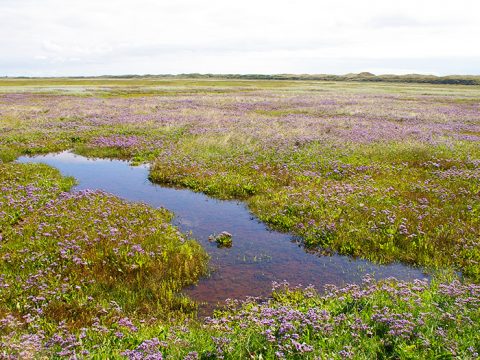
Water found in ditches in the woods and puddles on marshes sometimes have a thin layer floating on the surface that looks like oil. Most people are so accustomed to seeing dirty water that they assume this film is a sign of pollution. However if you stick your finger in it, the film breaks apart into small specks whereas a film of oil remains more or less an entity. This film is an iron bacteria and totally natural. Water on Texel contains a high amount of iron. So it's not strange to find this bacterium here. In the picture above, you see footprints from a bird in the iron bacteria.
Bacteria are also very important in purifying wastewater. They grow on the organic material and nitrogen and phosphate compounds, forming flakes which sink to the bottom. This mud is easy to remove from the water. On Texel, the mud is dried and sold for various industrial processes, such as cement-making. There is also an extra water purification stage on Texel, the helophyte filter. Again, bacteria play an important role by removing even more organic material out of the practically drinkable water.
WWW
See also
Info
Copyright Ecomare