Content on this page requires a newer version of Adobe Flash Player.

Get Adobe Flash player


Search in the Encyclopedia

Dieren en planten

Wasps   Digger wasps   Plants   Sedge family   Flea sedge   Sea club-rush   Salt marsh flora   Green flowers   

Water en land

Mens en Milieu

Sea club-rush

size:

15 to 150 centimeters

color:

leaf: green
ear: light brow

blossoms:

June through August

pollination:

wind

reproduction:

seed, creeping root stocks

life span:

perennial

  • Dut: Heen
  • Lat: Bolboschoenus maritimus, Scirpus maritimus
  • Eng: Sea club-rush,alkali
  • Ger: Strand Simse
Sea club-rush, Foto Fitis, www.fotofitis.nl

Sea club-rush

With a name like sea club-rush, you would assume that the plant belongs to the rush family and that it is resistant to salty conditions. Sea club-rush is a sedge. And although it can survive a flood of seawater for a short time, it will die if the flood lasts too long. Sea club-rush prefers to grow with its roots in fresh or brackish water. Various insects use this plant as their food source, such as a specific hoverfly and digging wasp. Cattle and swine like to eat the plant as well. Overwintering geese eat the tuberous roots. And even people used to consume sea club-rush: the sweet-tasting roots were ground for flour.

  • Deistribution and habitat

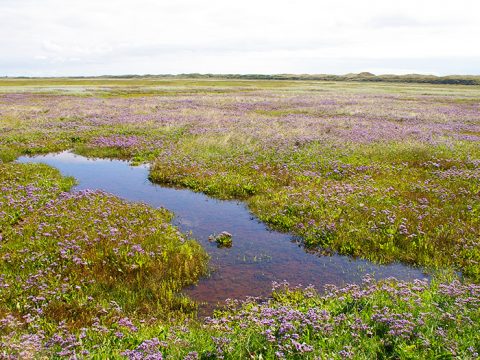
    Sea club-rush is found particularly on the higher regions of beach plains, where it grows in pools and gullies filled with rainwater or freshwater seepage. The soil is usually salty to some extreme. Sea club-rush is commonly found in the Netherlands in a 50 kilometer-wide strip along the North Sea coast. Although less common, it also grows inland along the banks of large rivers.