Content on this page requires a newer version of Adobe Flash Player.

Get Adobe Flash player


Search in the Encyclopedia

Dieren en planten

Animals   Plants   Diatoms   Green seaweed   Ulva   Gutweed   Eelgrass   Micro-organisms   Bacteria   Cyanobacteria   Phytoplankton   Flora on tidal flats   Fauna in tidal areas   Benthic fauna   Fish   Birds   Mammals   Aquatic plants   

Water en land

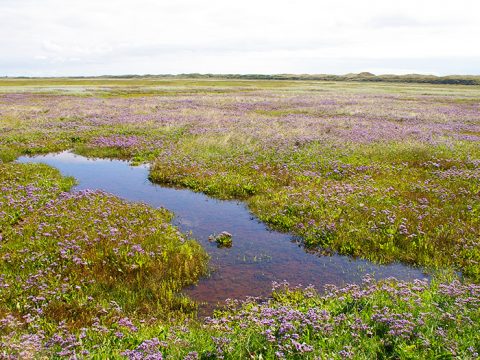
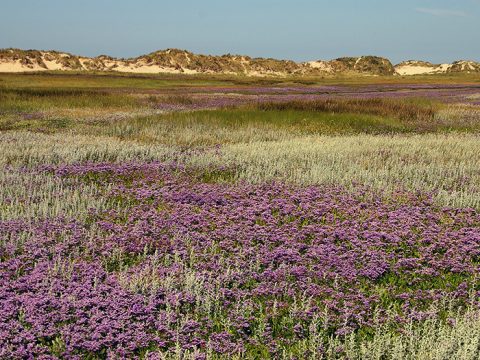
Tidal flat flora, Foto Fitis, www.fotofitis.nl

Flora of the tidal flats

At first sight, it seems like the tidal flats are bare of any growth. At the most, maybe there is some seaweed strewn over a few areas. However, it is deceptive. Most plant life on the flats is microscopically small. One-celled algae, specifically diatoms, make up the majority of the plant life. One-celled plants are called phytoplankton. Extensive fields of eelgrass covered areas of the Dutch tidal flats prior to the 1930s. However, most has disappeared due to disease and changes in sea currents.

On Texel


, Sytske Dijksen, www.fotofitis.nl

The wadden dike on Texel is not one straight line. Specifically in the bends, large masses of sea lettuce and gutweed accumulate during the summer. The amount depends upon the wind and sea currents. The mudflats by De Cocksdorp is a good example. In some years, the seaweed mass eventually rots, using up the oxygen in the water. In that case, many animals living in the mud under the rotting seaweed suffocate to death.

  • The algae film

    The most important flora community of the tidal flats is a film of one-celled algae, blue-green algae (cyano bacteria) and other bacteria. They live on the boundary between the bottom of the tidal flats and the water, or during low tide, the air. This film is visible with the naked eye as a brownish deposit on the gray mud. Some algae live deeper down in the bottom, up to several decimeters deep, and can survive in the (oxygen-deficient) tidal floor for several years.

    The layer of algae may seem insignificant, however it plays a major role in the tidal flat ecosystem: this is where nutrients from minerals and sunlight for the rest of the food chain are produced. Lugworms, Corophiums, 'grazing' shellfish such as Baltic tellin and snails such as laver spire shells and periwinkles live off of this film. In turn, they form the staple diet for the fish and birds of the flats. The process of growing (building up as a food source) and being eaten happens so quickly that the amount of algae remains low. Around four-fifths of the total food production in the Wadden Sea is ascribed to the algae film; the phytoplankton floating in the Wadden Sea water accounts for just about the rest. The tiny percentage leftover is accounted for by seaweed and eelgrass.

    The algae film also plays an important role as 'mud catcher'. Algae excrete materials to which the mud particles stick. Therefore, tidal flats with lots of algae are less sensitive to erosion than algae-poor flats. Storms, of course, can wash away a substantial amount of the algae film. The algae community must then rebuild itself from algae located deeper down in the tidal floor.