Content on this page requires a newer version of Adobe Flash Player.

Get Adobe Flash player


Search in the Encyclopedia

Water en land

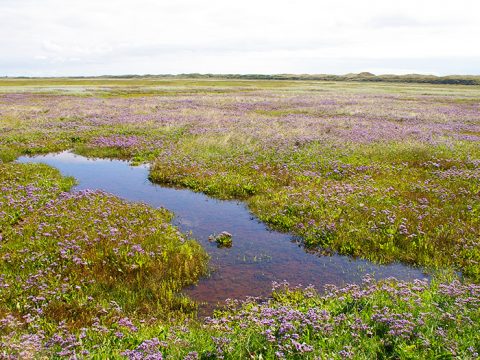
Salt marsh, Foto Fitis, www.fotofitis.nl

Flora on salt marshes

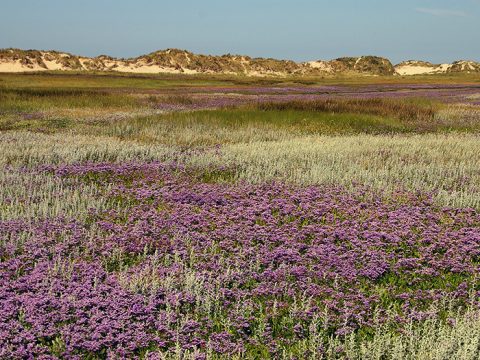
If a plant wants to grow on a salt marsh, it has to tolerate occasional salty baths. The advantage is that not many plants are capable of surviving such baths so that competition is low. Many species, such as sea lavender, can turn a marsh into a blanket of purplish pink when massive numbers flower in the summer. Later on in the autumn, the glasswort and annual sea-blite turn the marsh red. You don't see much vegetation in the winter, since most salt marsh plants are either annuals or spend the winter underground. The only plant life you are sure to find during the cold months is saltmarsh grass, which can remain green the entire year as long as the winter is not too severe.

On Texel


, Eckhart Boot, Natuurmonumenten

Up till the 19th century, Texel had an extensive salt marsh called the Buitenveld ('outer field'). It was reclaimed in the 19th century and is now known as the Eierlandse polder and the Eendracht. There is still a small part remaining, the nature reservation de Schorren. There are also salt marshes found in the Mok Bay, in the Slufter and a kilometer north of De Cocksdorp. Besides the normal salt marsh plants, a few unusual species are also found: annual sea purslane and golden samphire.

  • Tough plants

    Salt marsh plants live in the transition zone between land and sea. In order for them to live and survive in coastal regions, they have to be able to cope with salt water flooding, dryness during low tide, waves and varying temperatures and salinity. To overcome such difficult living conditions, salt marsh plants have become specialists.

    Plants that resist salt water flooding are referred to as 'salt-tolerant'. The best known salt marsh plant is glasswort, or salicornia, which is also harvested as a silty vegetable. It looks a lot like a succulent, with its bulging stems.

    Many salt marsh plants have glands on their leaves which help them to get rid of excessive amounts of salt. Other species have a different strategy. They store the salt in their lowest leaves, which eventually die and fall off. Some salt marsh plants are capable of protecting their flowers from the sea water. Should the plant threaten to come under water during flood, greater sea-spurrey closes its white petals, catching an air bubble in between to protect the flowering parts from the water.

  • Zones on the marsh

    On the salt marshes, you see obvious zones with various growth. These differences are related to the degree of resistance to salt and the periods of immersion. Some plants are more tolerant than others, allowing them to grow where the ground level is lower, closer to the low tide waterline. The changes in growth on a marsh can be seen best when moving from the bare tidal flat to the upper marsh. In general, salt inhibits growth, resulting in slow development.

    You first find glasswort, which tolerates long periods of seawater flooding. Cord grass also grows in this zone, usually in large clumps along the creeks. Moving to slightly higher grounds, around the high tide line, saltmarsh grass and sea aster can germinate. Advancing further up, in the middle marsh, you find sea lavender, sea wormwood, sea purslane and greater sea-spurrey dominating. The seawater doesn't reach this area with every flood. Finally, you are on the upper marsh, where it is obvious that the influence of the sea has diminished. Species of plants grow here which are less tolerant of flooding and salt, such as thrift, creeping red fescue and sea couch. Here you will also find normal land plants growing.

    Below is a table of the most likely place to find the various salt marsh plants. In reality, there is much interaction between the zones.

    low tide to high tide waterlinehigh tide to spring tide waterline
       

    glasswort (salicornia)

    cord grass

    saltmarsh grass

    sea aster

    sea plantain

    annual seablite

    sea lavender

    sea purslane

    greater sea-spurrey

    sea milkwort
    sea arrowgrass

    spring tide to upper marsh upper marsh
       

    sea club-rush

    Long-leaved scurvygrass

    sea wormwood

    thrift

    lesser centaury

    buck's-horn plantain

    knotted pearlwort

    red bartsia

    saltmarsh rush
       
  • Significance for fauna
    The Schorren on Texel, Foto Fitis, www.fotofitis.nl

    Salt marshes attract more land animals than marine animals. Brent geese and hares forage on the sweet tasting saltmarsh grass. The tips, young branches and seeds of the glasswort are food for wigeon and geese. Around 300 different species of wasps, a large number of hover-flies and more than a hundred species of aphids live in on the marsh when it flowers in the summer. There is even one aphid species which lives exclusively off of sea lavender.

    Marsh plants are only eaten by people on a limited scale in the North Sea region. In the marsh area in the Province of Zeeland, glasswort and sea aster are cultivated as vegetables. The leaves of the sea aster are called 'sea lavender' in their vegetable stores, which can be very confusing. There are other silty vegetable species as well, but they grow either along the beach ridge or sea dikes.

    Since earlier days, salt marshes have been used as pastures, especially for sheep and young cattle. It is said that the sheep produce extra tasty meat thanks to the salty grass they eat!