Content on this page requires a newer version of Adobe Flash Player.

Get Adobe Flash player


Search in the Encyclopedia

Dieren en planten

Water en land

Danish wadden region   Fanø   

Mens en Milieu

House on Fanø, Ecomare

Fanø

Fanø is the most northerly inhabited Wadden Island, situated between Mandø and Skallingen. The island is around 56 square kilometers and had around 3300 residents in 1990.

  • Geological history

    Fanø is a dune island, and just like the other West and East Frisian Islands, was formed from pole desert sand from the last glacial period.

  • Nature on Fanø

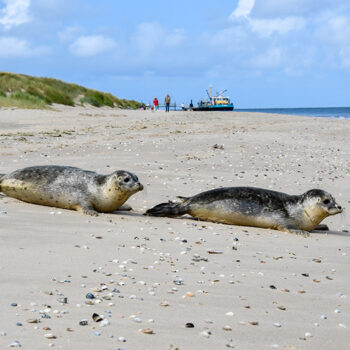
    The landscape of Fanø consists of dunes, beach and clay soils. There are also several duck decoys here. The beach is very wide. Sandbanks connected together on the north side of the island run parallel to the coast.
    There are 6 rows of dunes on Fanø, which formed from the large amounts of sand that washed ashore. The dunes in the east are the oldest on the island. The tallest dune, the Kikkebjerg (17 meters), is also found here. The dunes are overgrown with heather. Between the rows of dunes are plains which are partially used for farming.
    The land tongue Hünen formed around 1900 by the southern tip of the island, consisting of dunes and salt marshes. The top of Hünen is protected from erosion thanks to coastal defence regulations.
    In 1892, the 1162 hectare-large dune woods was planted. The forestation was meant to hold down the wind-blown sand and produce lumber. Nowadays, this woods is also enjoyed by tourists. Several species of black pine in particular were planted, with occasional deciduous trees, such as birch, oak and beech. There are also a few marshy areas varying in size located here.
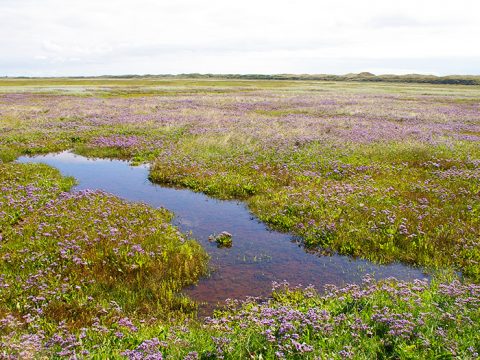
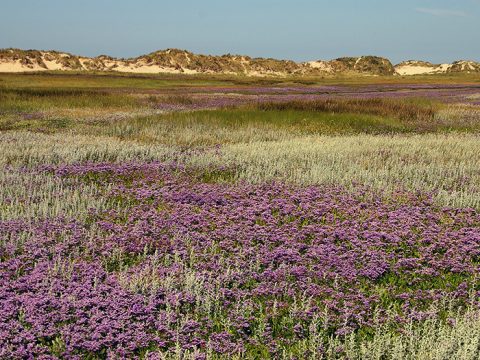
    A wide marsh is located at the northern tip of Fanø: 'Grünningen'. This marsh does not resemble the marshes on the east coast of Fanø, vegetation-wise, which was used as hayland in earlier days. Grünningen formed on a sandbank, while the marshes on the east coast have a clay underground. The clay grounds on Fanø are partially used as pastures and partially for harvesting reed.

  • Duck decoy

    In the period 1860-1888, three duck decoys were built on Fanø. Exploitation was forbidden in 1931. Two decoys were restored and redesigned as open air museum. One of the decoys serves as a (bidr) ringing station.

  • History of Fanø

    The oldest traces of settlements on Fanø date back to the 12th century. The island was also mentioned in the King's ground book.
    Life on the island was made difficult by coastal erosion, particularly in the period 1560-1660. The protective vegetation in the dunes disappeared due to overgrazing so that sand had free play. In the 17th century, one began to combat coastal erosion seriously through forestation.
    In 1741, Christiaan VI sold the island, including the hunting and beach rights, to the residents, who lived in those days by fishing.
    In the course of the 18th century, many men earned their money as seamen. Sønderho was home base for the second largest trading fleet of the Danish kingdom during its heyday. Today, the residents of Fanø still earn their wages in the fisheries and shipping.

  • Tourism

    Tourism on Fanø was launched around 1850. A swimming pool was built in the harbour, while dressing wagons for beach guests appeared on the west coast. Esbjerg had been connected to the train system several years prior. A ferry service with a small steamer motored between Esbjerg and Fanø.
    In 1890, the nameless company 'Noordzeebadplaats Fanø NV' was founded in Hamburg. This company was responsible for providing the necessary financial means for expanding Fanø. Plots on Fanø were sold to wealthy people in several large European cities. Furthermore, expensive villas were built on the island.
    In the first half of the 20th century, particularly between the two world wars, the number of visitors dropped. Tourism began to grow again in the 1960s and 1970s. A massive number of summer houses were built on the island, visitors could reach the island by car and drive almost everywhere, including the beaches.

  • Transportation

    A car-ferry operates between Esbjerg and Nordby on Fanø.