Content on this page requires a newer version of Adobe Flash Player.

Get Adobe Flash player


Search in the Encyclopedia

Dieren en planten

Water en land

Danish wadden region   Rømø   

Mens en Milieu

Rømø, Naturcentret, Ecomare

Rømø

Rømø lies between the islands Sylt and Mandø. Since 1949, the island has been connected to the mainland by a 10-kilometer long causeway. Around 800 people presently live on this 130-square kilometer island. Rømø has lots of nature, several villages and many places of interest.

  • Geological history

    Just like the West and East Frisian islands, Rømø is a dune island that original formed from pole desert sand from the last glacial period. The island is extremely young and is presumably created around the year ). Nowadays, continual sand transportation helps Rømø to grow in size.

  • History

    Just like all dune islands, farming was not sufficient to make a living. So the men on Rømø signed up to hunt whales and later on to merchant ships. A number of commanders (captains of the whalers) even lived on Rømø, which is still evident on some houses.
    Due to too much grazing, the vegetation of the dunes disappeared in the 17th and 18th centuries. The dunes became 'wandering' drifting dunes; the drifting sand threatened the pastures and the inhabited regions. Forestry ended this wandering and also provided wood to burn.
    The first tourists came to the island around 1900. The preacher Jacobsen from Skaerebaek established the first seaside resort by Lokolk. The guests were transported by horse-pulled tram from Kongsmark to Lakolk, where the ferry arrived. There was also a ferry connection between Ballum and Havneby.
    In 1960, a harbour was constructed by Havneby in order to stop the emigration of the inhabitants and to strengthen the economy. Shrimp fisheries began in 1968, giving Havneby a reputation as fishing village.

  • Nature on Rømø
    Rømø, Naturcentret, Ecomare

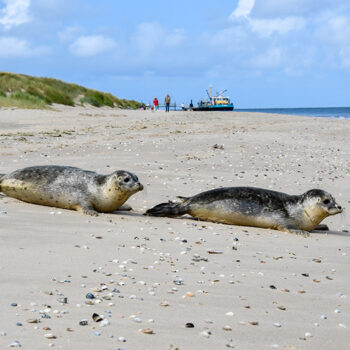
    The landscape on Rømø consists mainly of beach, dunes and clay grounds. There are large, undisturbed nature areas on the island and a major part is protected.
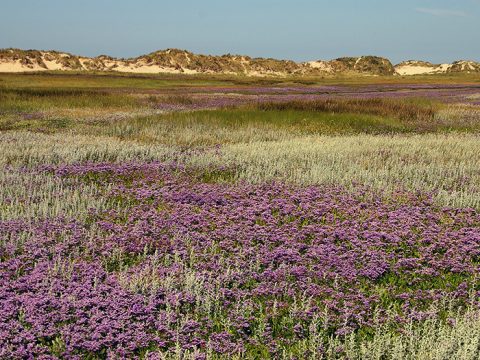
    Rømø has a large flat beach between 1 and 4 kilometers wide. The beach stretches out in a westerly direction. There are also various rows of dunes on Rømø, the most easterly being the oldest. A sand dike was constructed in the 1870s west of the Vriby plantation and the salt marshes, meant to combat further silting up of the marshes. The eastern dunes were kept from blowing away by forestation. The dune woods are mainly made up of black pine but is being replaced nowadays by deciduous trees for greater diversity.
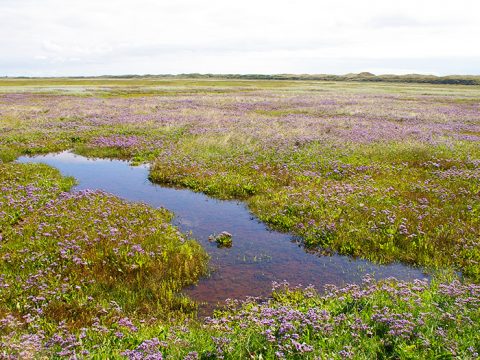
    Wind erosion of the younger dunes is combated by planting marram grass. There are sandy clay grounds located between the western row of dunes. The ground is many used for farming in the south. The clay ground on the marshes in the north is used by large numbers of birds. Lakes surrounded by reed are in the middle part of the island. On the east side lie the clay polders and marshes which are intensively used for farming. A large part of the clay grounds is pasture. South of the Havneby lie several outer marshes not in use by the farmers. The marsh ends by Kongsmark in a cliff around 1 meter high that is continually crumbling.
    The farmland plains in the north and south of the island are surrounded by dikes. The dikes were built in the south in 1867 and 1962 and the Juvredike in the north in 1928. When the Rømø dam was constructed, the Juvrepriel shifted north of the island, which consequently threatened the Juvredike. This dike had to be shifted inland in 1965.

  • Transportation

    Rømø is accessible by car from the mainland via the causeway. In addition, there is a (car) ferry between Sylt and Havneby.