Content on this page requires a newer version of Adobe Flash Player.

Get Adobe Flash player


Search in the Encyclopedia
Balgzand, Foto Fitis: www.fotofitis.nl

Balgzand

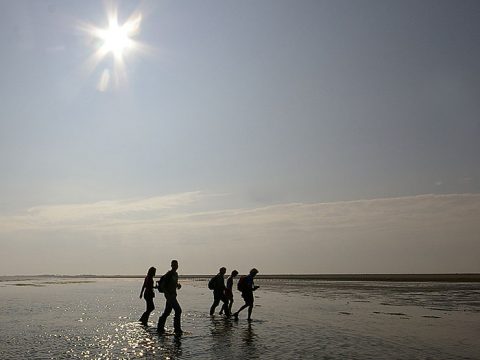
Balgzand is a large tidal flat located at the tip of mainland North-Holland, northeast of Den Helder. It is named after the Wierbalg, a channel which runs along side its border. The Balgzand is part of one of the largest nature areas in the Netherlands: the Wadden Sea. It consists primarily of mud-flats. During high tide, these flats are under water and invisible to us. During low tide, they bustle with activity. Tens of thousands of birds use the Balgzand to look for food. Lots of waders and ducks forage for a meal here. Shelducks use this isolated area when they molt their plumage. For migrating birds, the Balgzand is a true food paradise. They fill their bellies before continuing their voyage to their final destination.

  • Expansion

    The Balgzand is not a small tidal area, but has a surface area of around 6600 hectares. It lies in a wide bay in the Wadden Sea where water flows in from the east as well as the west during high tide. The sea currents clash together on the flats.

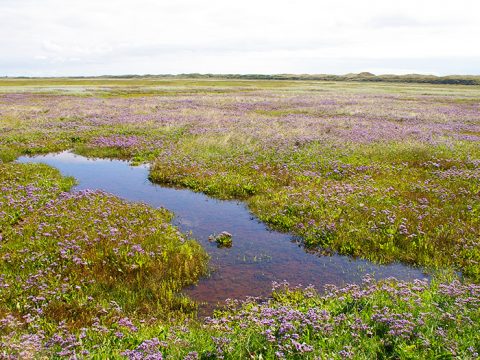
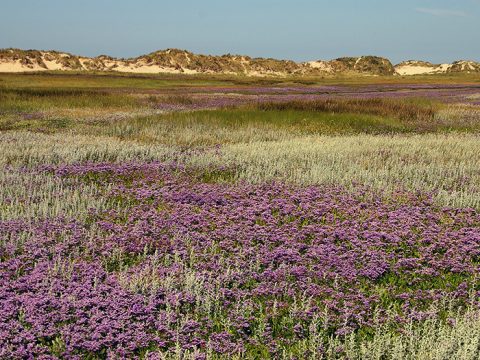
    Just like the rest of the Wadden Sea, the Balgzand is never the same. Mud is removed from the bottom by the currents and deposited elsewhere. There is so much mud in some places that the area remains exposed even during high tide. Plants are then able to grow, which is how the marshes are created. You find these marshes along the Balgzand dike, the dike which separates the nature area from the North Holland mainland.

    The amount of mud is still increasing and the shape of the marsh still changing, particularly in the southeastern part of the Balgzand.

  • Unique salt marshes

    The Balgzand salt marshes are not only beautiful but also very important, particularly for thousands of birds. For instance, the birds use the exposed areas for brooding. They build their nests here, lay their eggs and raise their young. Not a bad place either, with the tidal flats as a supermarket around the corner!

    The marsh has more functions. It is also used as foraging area and offers birds a safe place to be. The marsh is namely a so-called high-tide refuge. When 80% of the Balgzand floods during high tide, the birds can wait on the marsh until the tidal flats reappear during ebb.

    Did you know that marshes like those on the Balgzand are rare in the Netherlands? That's because of their low-growing salt-tolerant vegetation. In addition, the Balgzand forms an irreplaceable link in the worldwide migration route for birds.

  • Protection

    The dike along the marshes, and from which the Balgzand can be easily observed, is not open to the public. This insures the necessary peace for the birds in the area. Since 1988, a large part of the flats has been closed to the public during high tide. The birds are protected by the Nature Protection Act and the Penal Code. But to make it possible to observe the area without being seen by the wildlife, a bird hide was opened in 2006 in the Balgzand polder, making it easy to watch the birds without scaring them away.