Content on this page requires a newer version of Adobe Flash Player.

Get Adobe Flash player


Search in the Encyclopedia

Dieren en planten

Water en land

Frisian wadden coast   Nature   

Mens en Milieu

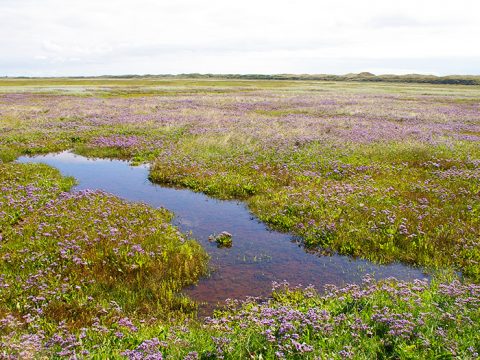
Salt marsh by Holwerd, Friesland, Ecomare

Nature in North-Friesland

Wadden nature along the North-Frisian coast can be divided into two regions: Noard Fryslān Būtendyks and the Makkumer Noordwaard/Makkumer Zuidwaard.

  • Noard Fryslān Būtendyks
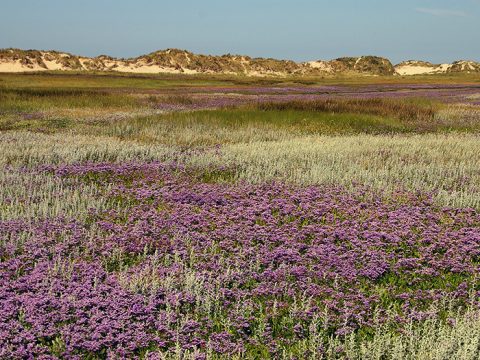
    Flowering sea aster, Noard Fryslān Būtendyks, Willem van Duin, Imares

    On the edge of the Wadden Sea lies Noard Fryslān Būtendyks, a region llying outside of the dikes northeast of the Bildt. The area consists of summer polders that are grazed (but due to the low surrounding seaward dikes, can flood during winter storms), salt marshes of which the high areas are grazed and bare slib fields which are inundated during high tide. A large part of the areas is less than 100 years old and was created as a result of intensive land reclamation works in the 1930s. The land formed by raising the marshes with mud. The mud could be accumulated by curbing the speed of the water using dams from brushwood (often willow branches) and poles and ditches with 90 degree bends.
    For years, the area had been a conflict between agriculture and nature protection. When the dikes had to be raised to Delta Height according to the Delta Act, there was an extensive discussion to determine where the dike should be placed. The choices were to build a new dike along the northern border of the land reclamation works or to raise the existing dike. In the first case, thousands of hectares of farmland would be created. In the second case, more nature area would be preserved. Eventually, the last option was chosen and the operation was completed in 1993.
    Noard Fryslān Būtendyks is very important for nesting and migrating birds as well as winter guests such as ducks and geese. The marsh vegetation consists of plants such as sea aster, sea purslane, cord-grass and salicorn. The area is closed during nesting season (1 April till 15 July), with the exception of the Sea Dike and a path for pedestrians.

    In September 2001, openings were made in the summer polder dike in Noard Fryslān Būtendyks so that ebb and flood again have free play on the former farmland. The purpose was to re-start the process of marsh-forming.

  • Makkumer Noordwaard/Makkumer Zuidwaard

    Sandbanks that were normally only exposed during low tide were suddenly permanently exposed when the Zuiderzee was closed off in 1932. A number of new terrains formed, such as the Makkumer Noordwaard, the Makkumer Zuidwaard and a number of others. Many of these regions have been cultivated over the years, however there are still a number of areas still left alone. These regions have developed into nature areas and are very attractive for birds, such as geese, ducks, grebes and cormorants.