Content on this page requires a newer version of Adobe Flash Player.

Get Adobe Flash player


Search in the Encyclopedia

Griend

number of residents:

0

main village:

none

total surface area:

0.5 square kilometer

important sources of income:

none

number of beds:

several, only for the rangers

unusual fauna:

sandwich tern, red-breasted merganser, grey seal

exceptional features:

protected by artificial dunes

Griend, GCN Terschelling

Griend

The bird island Griend lies within the boundaries of the town of Terschelling, halfway between the island and Harlingen. It is known for its rich bird life. In addition, it is one of the most important high-tide refuges in the wadden region. For these reasons, the island falls under the Nature Protection Act. Without protective measures from man, the island would probably have already disappeared in the waves.

  • Location
    Griend, Ecomare

    On the edge of the wadden region lies a row of lovely islands, running from west to east. They are mostly based upon old beach ridges which formed thousands of years ago on this slowly developing coast. The islands are referred to both as Wadden Islands and North Sea Islands.
    There is another island in the wadden region, but this island does not sit on an old beach ridge. It is located in the middle of the region. It is called Griend, no bigger than 500 meters in diameter. Being totally surrounded by the Wadden Sea, it is the only island which can truly call itself a Wadden Island.

  • Formation

    Griend is always named in one breath with Terschelling. However the island was formed in a very different manner.
    In the early Middle Ages, extensive salt marshes lay south of Terschelling, Ameland and Schiermonnikoog. The first pioneers probably departed for Terschelling via these salt marshes. Griend, a village or small city in those days, is on the highest part of such a marsh. During the St. Lucia flood on 14 December 1287, the village Griend was washed away. The area is a kind of 'hallig': an island built from remnants of salt marshes (halligs are still found in the German Wadden Sea). Erosion from the waves creates cliff coasts, which slowly but surely disappear into the sea. The surface area of Griend at the end of the 14th century was only 165 hectare.
    At one point, the current called the Vlie transported a large amount of sand, probably due to erosion of a coast somewhere else. Some of this sand was deposited on Griend, which lies exactly in line with the channel. Sand on the marsh dried and was blown by the wind. A low beach ridge several meters high was formed, in the shape of a sickle.
    There has been no question any more of a salt marsh since hundreds of years. Griend is now the highest part of the so-called Grienderwaard, an extensive tidal bank with old clay and sand layers not far under the surface. The northwest side of the island in particular lies open to the strong Vlie current. This current regularly attacks the low beach ridge and dunes during storms.
    The Vlie current runs westward of the Grienderwaard, the Meep is to the north and the Blauwe Slenk is to the south. Therefore, the island is surrounded by three deep channels on three sides. The east side is a transition to the tidal flats under the Frisian coast.
    Under influence of water and wind, the overgrown sickle-shaped island of Griend slowly moves sometimes more, sometimes less in an easterly direction. It moved around 350 meters between 1850 and 1910. According to calculations, it must had moved a total of several kilometers since the 13th century. The total surface area at the end of the 19th century was around 25 hectare.
    Up till 1932, there was a constant balance between erosion and growth; washed away sand on the west side settled again on the east side of the island. Fine particles settled on the east and new salt marshes formed between the arms of the beach ridge.
    The Vlie current reaches Griend during high tide due to a shallow channel in the Grienderwaard, more like a depression in the bottom. This channel then splits and flows in a northerly and southerly direction: the so-called 'zwin' (tideway). This shallow channel is only visible during low tide and stretches in a sickle form in front of the sickle-shaped ridge.

  • Development after 1932; threats

    In the early 1930s, things started to happen. The current direction of the Vlie changed due to the closure of the Zuiderzee, and because the difference between low tide and high tide increased, the current velocity also increased. Although it is totally unrelated, a disease caused the eelgrass to die off at the same time. When the plant died naturally in the autumn, it would form a thick bed and would drift along the coast of Griend, forming a reasonable protection from attacking waves during storms.
    These negative developments resulted in Griend being more open for attacks from a northwesterly direction. The beach ridge continued to decline in size and almost broke in the middle several times, which would mean the island would break in half. The 'zwin' (tideway) is no longer able keep up with the movement and lags a hundred meters behind. Griend is constantly flooded, having disastrous consequences for the nature. Even though it grew during quieter times, erosion dominated.
    The people from Rijkswaterstaat kept attempting to repair the damage or at least to limit it. Holes were closed up and complete sand dikes were spouted in front of the damaged beach ridge. Successes were only temporary.
    In the long run, the Delft Hydraulics Laboratory was called in to help. Their studies concluded that a sand dike had to be constructed running west to east along the western and northern side of the island. Currents would not be able to take hold, and the works would fit in well with the natural movement of Griend. The sand on the west side offers protection and should promote growth. In addition, it would serve as a sand buffer to help island to continue wandering. According to computer calculations, Griend should stay around another 80 years. The sand dike was completed in 1988 and the results have been positive up to the beginning of the 21st century. In the meantime, it is a matter of waiting to see whether or not the experts were right with their computer calculations.

  • Griend's value

    Why all the effort for such a small island that is no larger than 25 hectare?
    Actually, the bare name Griend has shortcomings. The island should be called 'bird island Griend'. People have nothing to look for on the island; the vegetation is nothing unusual. It is the birds that make the island so exceptional and that millions of euros are spent to preserve it. It is one of the most important nesting areas for sandwich terns and an important nesting area for Arctic and common terns. It's all about terns. In addition, the 8000-hectare large Grienderwaard is an important foraging area for numerous migrating birds, which can only be foraged if Griend is nearby to serve as a high-tide refuge. Specifically for these birds, Natuurmonumenten has been renting this island since 1917 and has it in long lease since 1975.

  • Vegetation
    Griend, Ecomare

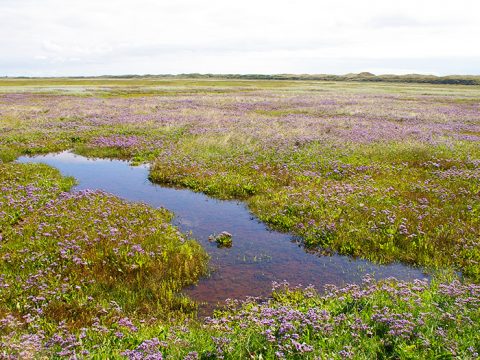
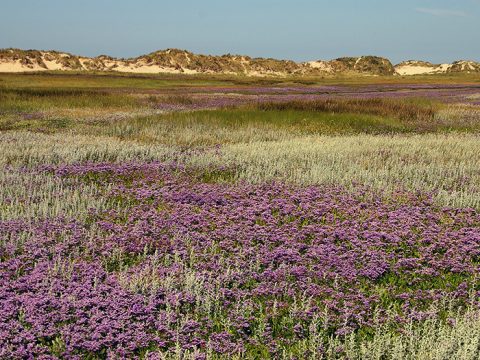
    The bird island Griend wanders. After dozens of years after the salt marsh has formed on the east side, it starts forming on the west side. The entire island is swept around! A vegetation can hardly begin to develop. The pioneers among the plants must keep starting anew. There is barely any succession to speak of (plant communities which take over from others due to changing conditions). Due to an increase in flooding, life is made impossible for salt-intolerant plants. Therefore, in periods of erosion, the number of species declines and the vegetation thins out.
    When Rijkswaterstaat is busy with some kind of preservation or even expansion, a little bit of succession takes place and more species get a chance - until the next series of attacks from the sea.

  • Bird island

    Birds can always be found on the island of Griend. Usually many to very many. It has been that way for centuries. Gathering eggs on Griend used to be a favourite activity among the islanders of Terschelling.
    Griend is a high-tide refuge for innumerous birds the whole year long. However in the summertime, the nesting birds dominate the scene. And then they are a special kind of nesting bird: those that breed in colonies.

  • Colony brooders

    The colony breeders of Griend are terns and gulls. One gull species: the black-headed gull. And three, sometimes four tern species: the sandwich tern, the Arctic tern, the common tern and sometimes the little tern; however the number of the latter in recent years is hardly worth mentioning.
    The terns appear almost simultaneously in their nesting grounds. The first begin building nests in April.
    The sandwich terns with their black legs, black beaks with a yellow tip and a 'cowlick', breed close together on the beach ridge. More than half of the total sandwich tern population of the Netherlands nests on Griend. There were 8207 pairs counted in 2001.
    The Netherlands is the most southerly border for breeding Arctic terns and it is considered a fairly rare nesting bird in the region. Griend accommodates around one third of the Dutch population. The pairs breed on the edge of the beach in the bare sand.
    A large part of the total population of common terns in the Netherlands is also found on Griend. In a good year, it can mean more than 1000 pairs. They look for the fairly thick growth on the beach ridge to build their nests.
    And between all of these nests are the nests of thousands of pairs of black-headed gulls, easily recognizable with their black head. They fill up all of the last open spaces. They can be found anywhere where there is some reasonable vegetation, particularly on the beach ridge.
    Nesting on Griend has its advantages. There are no predators such as foxes; in addition, no plundering birds such as herring gulls nest here. In addition, Griend lies extremely advantageous with respect to rich fishing grounds.

  • Accessibility

    Griend is not accessible for the public. In fact, it is forbidden to trespass. The Foundation for the Preservation of Nature Monuments (Natuurmonumenten) leases the island and has designated it for birds. It is one of the very few places in the Netherlands exclusively designated for nature and, with the exception of scientific studies, no other joint use. Every once in awhile, Natuurmonumenten organizes a day to remove the marine litter washed ashore on the island, such as nets, plastic, lamps, crates and bottles.
    During the summer part of the year, two bird wardens live on Griend to keep curious people at a distance. In addition, the NIOZ performs studies on the knot.