Content on this page requires a newer version of Adobe Flash Player.

Get Adobe Flash player


, Foto Fitis, www.fotofitis.nl

The Slufter

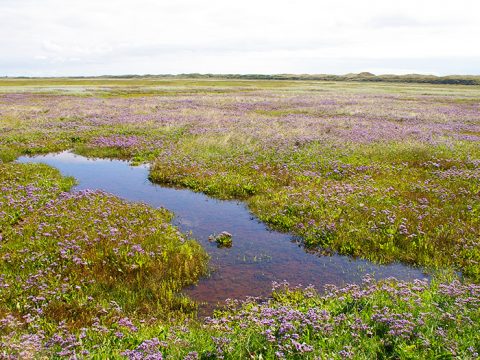
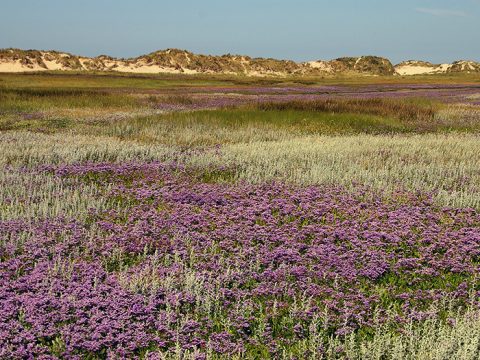
The best known nature area on Texel is the Slufter, situated between the Muy and the Eierland Dunes. It is a large salt marsh plain lying between two wind-born sand dikes. What makes the Slufter zo unusual is its location on the North Sea coast. Salt marshes are generally found along the Wadden Sea shores. Should it storm, watch out for wet feet, since this area is directly connected to the North Sea. During heavy westerly winds and spring tide, the seawater penetrates far into the Slufter. Many unusual plants grow here, plants that tolerate salt water to varying degrees. The Slufter is dissected by a creek system which extends far inland. The Slufter valley turns purple in the summer from the flowering sea lavender and red in the autumn from the aging salicorn. The largest part of the Slufter is closed to the public. It is managed as a bird reserve, where you find eiders and sky larks among the nesting birds. The southern section is open to the public and is also accessible to those in wheelchairs.

  • Unsuccessful closure
    Part of the map of Texel in the 17th century, CD 5-10

    The Slufter owes its existence to human hands. Since the 15th century, the area between Texel and Eierland was a shallow channel with elevated sandbanks. Between 1629 and 1630, a dike was constructed across the channel from wind-born sand, tne Zanddijk. After the sea channel was closed off, land on both sides of the dike continued to form.
    In 1855, a new wind-born sand dike was constructed about one and a half kilometers west of the Zanddijk. This dike was named the Lange ('long') Dam. The Lange Dam linked the Slufterbollen (the dunes north of the Muy) with the Eierlandse Dunes. Unfortunately for the Texelaars, this dike did not last for long.
    In 1858, the Lange Dam was breached in three places. Deep channels formed, flowing into the beach plains lying behind. These channels were named the Large and Small Slufter and the Muy. After a number of attempts, the Large Slufter and the Muy were finally repaired in 1887. However, the Small Slufter kept growing and was more difficult to close. There were two repairs made in 1902 and 1910, but new breaches again forced openings. The last attempt to close the Slufter was made in 1925. When this attempt failed, nature conservationists successfully pleaded for truning the Slufter into a nature area.

  • Open connection with the North Sea
    Slufter, foto fitis, sytske dijksen

    When you visit the Slufter and climb over the dunes via the stone stairs, you can't miss the North Sea in the distance. You also see a large channel where the sea flows into the Slufter unhindered during high tide. The entire valley can fill with seawater during storms. The channel retains its depth when the water flows back into the sea. When the current is slow, small mud particles are deposited. This is how a muddy bottom forms, which you see mostly in the northern section of the Slufter. The water flows the fastest around the main channel where the plains are much sandier.

  • Sea lavender and honey bees
    Sea lavender in the Slufter, foto fitis, sytske dijksen

    In July and August, there is an explosion of flowering sea lavender in the Slufter. The plant stands at elevations which do not flood daily with seawater. Sea lavender produces lots of nectar, making it an important flower forbutterflies and honey bees. There are several colonies of bees around the Slufter in the summer months. They belong to Texel beekeepers and the number of colonies is limited. The State Forestry only allows a maximum of 12 hives in the area in order to give wild bees and other nectar-feeders a chance. Sea lavender honey has a notable silty flavor and a greenish-yellow color. It is a typical wadden product.

  • An eldorado for birds
    Brooding eider (Farne Islands), Foto Fitis, www.fotofitis.nl

    Thanks to the space, tranquility and the presence of the salt marsh, the Slufter is an el dorado for birds. And it is very important for many different species of birds, particularly in the northern part of the Slufter. Since it was closed to the public in 1990, its importance has grown even more. The Slufter is home to many waders, gulls and ducks searching for food on the marsh and in the muddy bottom. A varying number of little terns nest on the beach plains by the mouth of the Slufter. The smallest tern species make their inconspicuous nests between the shell banks. The majority of the Texel eiders use the Slufter for brooding. In 2009, 120 of the 140 nests were counted here. After the eggs hatch, the families gather together in the deeper channels. In the winter, wigeon, northern pintails and common teal prefer the higher grounds in the salt marsh. There are also lots of seed-feeders, such as snow buntings, twites and shore larks. Even hooded crows and rough-legged buzzards sometimes spend the winter here.

  • Sand in the Slufter
    Slufter, foto fitis, sytske dijksen

    For years, it has been known that the Slufter channel is slowly but surely growing narrower and shallower. It's not surprising, since coastal systems such as the Slufter are never stable. It is also occurring elsewhere, such as the Notch by Schoorl. The process occurs on an irregular basis, going faster in some places than in others. There are two major forces involved in the Slufter. The force of the tides and the flow of water from above (rainwater flowing to sea) keep the Slufter open. The force of sand transportation along the coast advances its closure: every time the Slufter valley floods, sand from the sea enters the area and some of it stays behind. Therefore, the valley keeps growing higher which decreases the force of the tides. Sometimes, a major storm removes lots of sand from the Slufter. There are also factors that accelerate the sand nourishment process. The long breakwater by Eierland has led to an additional supply of sand, as have the sand nourishments by the Texel beaches south of the Slufter.

  • Storm
    Storm, foto fitis, sytske dijksen

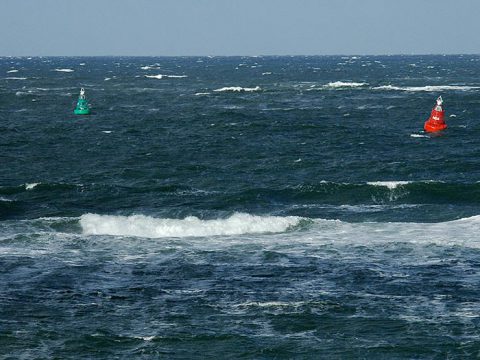
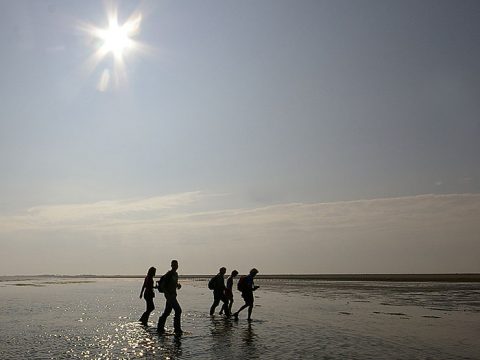
    The Slufter during a northwesterly storm is a spectacular experience. When there is also spring tide, (extra high flood) the sea thunders inland. From the stairs, you see a large surface of water. Only the crowns of several dunes stick out of the water. Should you walk in the Slufter after such a storm, you will find large piles of plant remnants, sometimes located 2 meters up the dune slopes. This shows you how high the water level was during the storm. When the tide is extra low, again during spring tide, in combination with an easterly wind, the experience is totally different. The main channel is so shallow you can easily wade to the other side.

  • Wandering channel
    working in the Slufter, foto fitis, sytske dijksen

    The large Slufter channel meanders. From the flowing seawater in and out of the channel, sand is deposited on the one side and washed away on the other side. Because of this, the mouth of the main channel moves over the years from south to north. When the channel threatens to reach the northern dunes, the Water Board digs a new channel southwards and closes off the northern channel. This happens every five years. The last time was in 2009. This time, the curve in the channel was also restructured in such a way that the seawater is now able to flow deeper into the Slufter.

The Slufter