Content on this page requires a newer version of Adobe Flash Player.

Get Adobe Flash player


polder Eijerland, foto fitis, sytske dijksen

Polder Eijerland

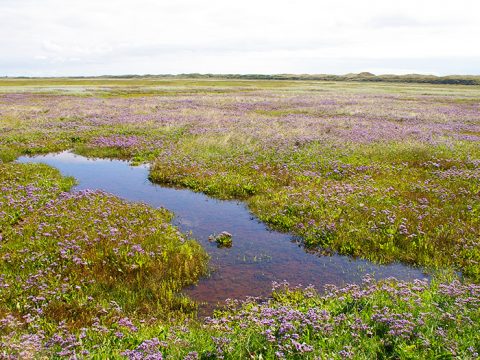
Polder Eijerland was reclaimed in 1835. The landscape is very different than on the old lands of Texel. It is a modern polder with straight roads and large square fields. Nevertheless, there are still elements from the former wetlands found in the form of the old creeks: the Roggesloot bordering De Cocksdorp and the Hogezandskil in the eastern part of the polder.

  • Impoldering
    old creeks are still visible, foto fitis, sytske dijksen

    Polder Eierland's history began around 1620 when the sea channel Anegat between Texel and Eierland was dammed. A wind-blown dike was built on the west side of the polder. Over the following two centuries, an extensive salt marsh, the Buitenveld ('outer field') formed east of the dike. It looked similar to the present Boschplaat located on Terschelling.

    Around 1830, a company led by the Belgium shipowner de Cock began to reclaim the polder. A dike, more than eleven kilometers long, was built around the high salt marsh. The land was leveled and made suitable for farming. The first farmers came from different regions in the Netherlands. The names and the building styles of the farmsteads recall their origin:  'Breda', 'Hunsingo' en 'Rotterdam'. The old sea dike from the Koger land and the polder Waal and Burg is called the Ruigendike. This dike is now the southern border of the polder Eijerland. 'Behind the Ruigendike' is still different than elsewhere on Texel.  The landscape is open, there is an airport and a motor cross terrain and, it is said, it is inhabited by wild freebooters.

  • Airport
    Texel airport, foto fitis, sytske dijksen

    The international airport 'De Vlijt' is situated in the polder Eijerland. Since its opening in 1937, you could fly to Schiphol at two various times per day. This route was discontinued during the Second World War and has never been re-started. The airport has a grass runway. Even though this is a limitation, landing on a grass field is a charming element for many users.

    You can book touring flights, learn parachute jumping and fly a glider plant a Texel airport. The Texel's Museum for Aviation is also located on the Vlijt complex.

  • Zuid-Eierland (South Eierland) and Moai statue
    Scholerie and Moai statue, foto fitis, sytske dijksen

    Zuid-Eierland is located in south of the airport. Most of the inhabitants work in the polder. The most striking building is the Scholerie. The building used to be a school and has since been converted into an art gallery.
    A Moai statue, known from Easter Island, stands outside of the Scholerie. The first European that landed on this island in the Pacific Ocean in 1722 was the explorer Jacob Roggeveen, who had departed from the Roads of Texel. The owner of the Scholerie, painter Niek Welboren, asked a sculptor from Easter Island to make a Moai statue on Texel.

  • Midden Eierland
    southern part of Eijerland, foto fitis, sytske dijksen

    Midden Eierland lies in the center of the polder Eijerland. Most of the inhabitants of this hamlet work in the agrarian sector.

  • Spoonbills in Eierland
    The principle of the stickleback passage, Ecomare

    In the early spring, spoonbills search for food in the shallow polder ditches. They catch small fish, such as three-spined sticklebacks. Later in the season, the birds fish for shrimp in the tidal flat channels.
    In order to help both the spoonbills as well as the sticklebacks, a fish passage was built in 1996 near De Cocksdorp. By releasing fresh water, large numbers of sticklebacks are attracted. The fish are lured to a catch basin with the flow of fresh water, and then sucked over the dike with the help of a siphon. The fish are then able to migrate further into the polder to lay their eggs. More fish and better for the spoonbills.

  • Roggesloot
    Roggesloot, foto fitis, sytske dijksen

    The Roggesloot lies southeast of De Cocksdorp. You can still recognize the old tidal channel. There are five hills visible in the landscape east of the Roggesloot. These are 'nollen' (low dunes). Before the dike construction in 1835, these nollen served as refuge for livestock when the salt marsh flooded during extremely high tides.
    The Roggesloot and the land along the banks belong to the State Forestry. The area is rich in meadow and reed birds. There is even a fishing pier accessible for wheelchairs.

  • Hogezandskil
    Hogezandskil, foto fitis, sytske dijksen

    In the eastern part of the polder Eijerland is the remains of an old creek: the Hogezandskil. The government excavated clay here for re-enforcing the dikes. Nowadays, it is an elongated pond, managed by Natuurmonumenten since 1976. Many avocets and greylag geese nest here.

  • Fields with geese and swans
    Bewicks Swan, foto fitis, sytske dijksen

    The fields in Polder Eijerland are famous for their groups of Bewick swans in the winter. There are also bean geese, great white-fronted geese and Brent geese, but they blend in more with the background. Nor are they well-liked by the farmers. Bewick swans prefer sugar beet fields, which have just been harvested. They consume the leafy remnants, and there is no farmer who objects to that. Sometimes there are more than 500 birds sitting together. Bean geese often migrate together with the swans, while great white-fronted geese prefer grasslands. You find the Brent geese along the wadden dike.