Content on this page requires a newer version of Adobe Flash Player.

Get Adobe Flash player


Search in the Encyclopedia
Hallig Hooge, Foto Fitis, www.fotofitis.nl

Halligen

The Halligen form an archipel of small islands in the middle of the wadden region of Schleswig-Holstein. Most of them are not protected by dunes or dikes. There used to be more than 100 Halligen. Presently, there are only 10 and only a few are inhabited the entire year. The other Halligen are only occupied during the summer. Houses and other buildings on the Halligen are usually built on terpen. The Halligen have an unusual cultural history. Due to their isolation, many traditions and uses have been preserved.

  • Geological history

    The North Frisian coastal region, including the islands and the Halligen, have changed radically during the last century. The only remnants are primarily the ridges of sand and boulder clay from the Saalian, still found on Sylt, Amrum and Föhr. The only leftovers of the expansive clay grounds are the islands of Pellworm, Nordstrand and the Hallig Nordstrandischmoor. The other Halligen were formed by desposition on the old underground.

  • Terpen - living on the Halligen
    Flood pole on Hallig Hooge, Foto Fitis, www.fotofitis.nl

    In order to protect themselves and their personal property from floods, the coastal residents have been building artificial earthern hills since long ago. The residents of the Halligens still live on terpen, which is the only place to flee to during storms. Nowadays, the houses of the Halligen must also have a shelter located on the first floor, which is safe to escape to should the water destroy the walls of the ground floor.
    As soon as the terp was finished, one began to build a house on the top. First a wooden scaffold is constructed, whereby strong vertical oaken piles are beaten deep into the tidal flat bottom. These pillars are supported with stones or connected to the bottom of the terp with transect beams. These pillars are also connected together at roof height with transect beams, creating a stable frame for the house. This frame is then filled with bricks. Such a house on pillars has the advantage that an attic can serve as a safe shelter during floods. Should the walls be destroyed during a storm, the pillars keep the roof and attic in place. The waves do not hurt the pillars due to their small size. After the flood of 1962, the terpen of the Halligen were raised to 3 meters above the average high tide line. The terp profile was also adapted to the dike profile. Terpen must be continually raised nowadays, since the number of heavy storms has been increasing and sea level is rising.

  • Dikes on the Halligens

    In order to protect the Halligen from continual erosion, some of the islands were provided with coastal protection at the end of the 19th, beginning of the 20th century. Summer dikes were built on Hooge and Langeneß, protected with granite or basalt stones at the base. The summer dikes are low dikes which protect the land lying behind from floods in the summer. When heavier storms hit in the winter, the water washes over them. The number of floods has declined thanks to the summer dikes. Consequently, the land on the Halligen no longer silts up as much and therefore is not elevated at the past rate.
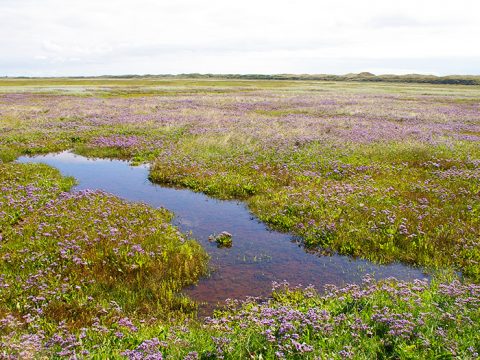
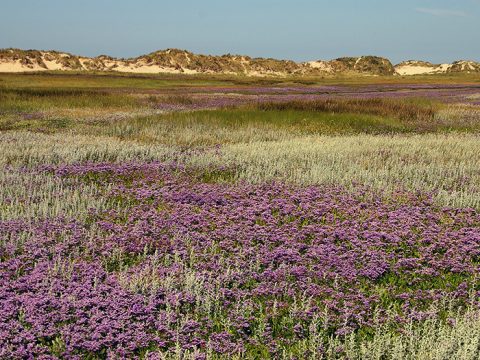
    The vegetation has also change, since the salty seawater no longer has the same kind of influence. Those plants that are adapted to salty conditions disappeared, such as sea meadow grass, sea lavender and salicorn. They have been replaced by red and white clover, as well as other typical meadow plants. The quality of the meadows has hereby improved when it comes to usage. Typical Hallig vegetation nowadays can still be found on the Halligen Süderoog en Gröde.

  • Living on the Halligen

    The residents on the Halligen used to be farmers; they sold hay and cattle to the mainland. They fished for their own consumption and used cow dung for fuel. Tourism began in the 1960s on the Halligen and newcomers, that worked elsewhere, came to live on the islands. That wasn't so good for the close-knit community.

  • Traditions

    The Halligen have two annual celebrations. Biikebrennen is a tradition celebrated on February 21. Large bonfires are lit. It used to be a pagan sacrificial feast. In the 17th century, it was a farewell ceremony for the men that went to sea. Nowadays, it is a party for the younger generation.

    On New Year's Eve, the small children walk from house to house, while singing and playing with a 'rommelpot', a kind of music instrument, and drums. They are rewarded with candy.