Content on this page requires a newer version of Adobe Flash Player.

Get Adobe Flash player


Search in the Encyclopedia

Dieren en planten

Water en land

Schleswig-Holstein   Nordfriesland region   Trischen   

Mens en Milieu

North Frisian farmstead Hauberg, now a museum, Ecomare

Nordfriesland region

Nordfriesland is the region on the west coast of Schleswig-Holstein, extending from the Danish border to the river Eider. The name refers to the days in the past when many Frisians lived here. A Frisian dialect is still spoken in scattered areas. Part of the Eiderstedt peninsula in the south lies in Nordfriesland. The river Eider forms the boundary between the regions Nordfriesland and Dithmarschen. The North Frisian Islands are: Pellworm, Nordstrand, Amrum, Föhr, Sylt and the Halligen (islets).

  • Geological history
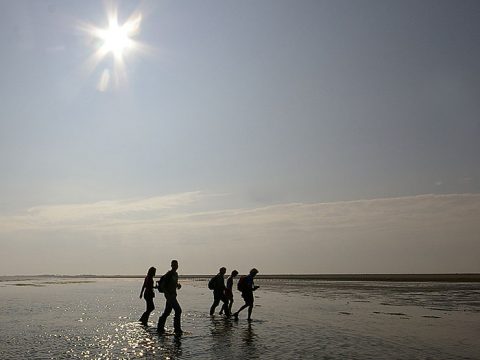
    Mudflats near Eiderstedt, foto fitis, sytske dijksen

    The sandy soils of Schleswig-Holstein were deposited during the second to last glacial period, called the Saalian in northern Europe and Wolstonian Stage in England. The ice shifted over this surface during the last glacial period, the Weichsel. The sea level rose when the Weichselian glaciation (called the Devensian glaciation in England) ended and large clay plains formed on the edge of the sandy grounds. When the sea level rose even higher, these clay plains were partially destroyed, leaving behind the islands off of the coast of Nordfriesland.

  • History
    Friedrichstadt, foto fitis, sytske dijksen

    Nordfriesland was colonized from the sea around the year 800 A.D. by the Frisians. They came from the West Frisian region, the present Dutch province Friesland. They fled north because the Franconians were in the process of conquering the land. The people first lived only lived on the coast. It took another 200 years before they colonized the mainland. The Frisians traded with the local people and farmed on the clay grounds. Many villages developed along the edges of the more elevated sandy grounds. The people residing on the clay grounds lived on terpen; later on, polders were created after the dikes were built. Nordfriesland has suffered much from flooding.

  • Nature and landscape

    The mainland of Nordfriesland is primarily marsh. Furthermore, there are sandy moraines dating back from the glacial period. The Wadden Sea and the islands lie in to the west. The coast consists mainly of dikes, however there is a cliff by Hattstett. Marshes lie behind the dikes. The Stolberg by Bredstedt is the highest point of Nordfriesland, 44 meters. People used to live here in earlier days on terpen, which can still be found scattered in the area.

  • Eiderstedt

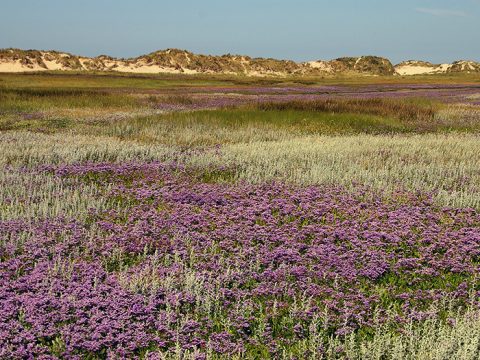
    The Eiderstedt peninsula is 30 kilometers long and 15 kilometers wide. It is made up of old marshland and polders on the north and east side. Dunes and beaches make up the west and south sides. Much of the original landscaped and nature has disappeared due to tourism. Strong winds have blown the dunes inland onto the marshes. This has created an unusual succession of areas: from the sea, you first have beach, followed by marsh, dunes and marsh.

  • Tümlauer Bucht

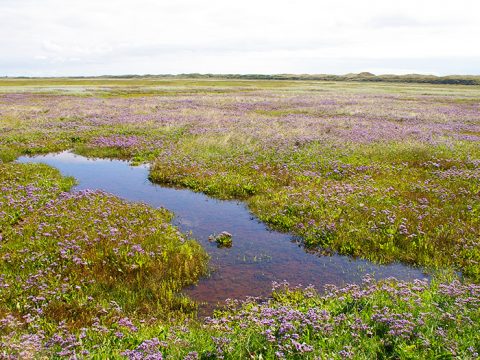
    The Tümlauer Bucht is a protected bay in the Wadden Sea, containing salt marshes and tidal flats. The vegetation is unusual because very little sand is blown into the bay. Brent geese, barnacle geese and wigeons are often seen here.