Content on this page requires a newer version of Adobe Flash Player.

Get Adobe Flash player


The boundaries of the PKB region, Ecomare

Key Planning Decision Wadden Sea - Third (PKB)

The Third PKB Wadden Sea is a decree in which governmental policy for the Wadden Sea for the period 2007-2017 will be established. The PKB is a further elaboration of the Planning Note. The main goal is sustainable protection and development of the Wadden Sea as a nature area and conservation of the unique open landscape. The policy for the Wadden Sea with respect to mutual relationships between nature protection, spatial planning, environment and water are described. This policy is further incorporated into other governmental decrees as well as provincial and town planning. The Third PKB Wadden Sea succeeds PKBs from 1992 and 1980 and was accepted by the Upper Chamber in December 2006.

  • Major goals
    The national government strives for a sustainable protection and development of the Wadden Sea as a nature area. This mean:
    - undisturbed development of water movements and the related geomorphologic and geological processes
    - sustainable protection of the quality of water, bottom and air
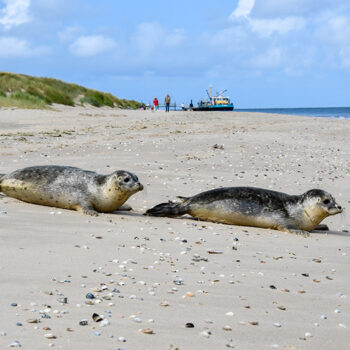
    - sustainable protection of (benthic) flora and fauna, such as forage, nest and rest areas for birds, birthing, haul-out, nursing and resting areas for marine mammals (seals in particular) the nursery function for North Sea fish
    - sustainable protection of the flora and fauna of the outer dike areas and the bordering dunes
    - retaining landscape qualities (the diversity and the specific character of the open landscape) and the value of experiencing nature and landscape
       
  • History of the PKB

    The PKB Wadden Sea is the successor to the Wadden Sea Note and describes the Wadden Sea policy for the coming ten years. The PKB consists of three parts: part 1 is the design note, which was ready in 2001. Part 2 is reactions to the design and part 3 contains the cabinet's point of view. After being handled in the Parliament, the PKB should have been approved in 2002 and put into effect, but it was delayed when the cabinet fell. In the meantime, the PKB was adapted and subjected to European habitat directives. Finally it was ready in 2006: after opportunities for public comment in the spring of 2006, the Ministers Council approved of part 3 in May 2006, so that it could go to the Parliament before the summer of 2006 and go into effect in early 2007.

  • People and the tidal flats

    The principles for managing the Wadden Sea are elaborated in the PKB, as was determined at the ministers conference in Esbjerg in 1991. According to the PKB, human use is allowed as long as the major goal is not put in danger. The necessity for the activity must be shown beforehand. When there are clear doubts concerning the activity due to possible consequences for the ecosystem, then preservation of the nature in the Wadden Sea will be the deciding factor (the precautionary principle).
    When activities are permitted in the Wadden Sea, the government stipulates that the best executable techniques are applied to prevent or limit negative environmental effects. One way to achieve this is with a zoning system.
    Temporary or permanent damage of the nature values in the Wadden Sea is only acceptable to the government if the damage to the environment can be compensated by doing something extra elsewhere in the region with respect to sustainable protection and development.
    Nature management in the Wadden Sea is directed at maintaining the present aerial of the salt marshes and the (more or less) closed drift dikes on the inhabited islands. On the islands themselves, maintaining the salt marshes will be safeguarded as much as possible. In order to obtain a natural transition to more dynamic areas, there must be extensive maintenance of the drift dikes in transition areas. Salt marsh works along the Frisian-Groningen mainland coast (the goal being to maintain the aerial of the marshes) will be continued in the most natural manner.
    Burdening the Wadden Sea with pollutants and nutrients will be reduced by not allowing any new discharges of unpurified wastewater into the Wadden Sea and the bordering harbours.

  • Relation with the Nature Protection Act and MER requirements

    The PKB Wadden Sea received a stronger legal status when the largest part of the Wadden Sea was proclaimed a State Monument in 1993, in the framework of the Nature Protection Act, since both are coupled together with approval of the Parliament. In addition, Environmental Effect Reports (MER) are now required to take place before activities are permitted in the wadden region.