Content on this page requires a newer version of Adobe Flash Player.

Get Adobe Flash player


Search in the Encyclopedia
Lecanesphaera shrimp , foto fitis, sytske dijksen

Brackish water regions

A brackish water region is characterized by a mixture of freshwater and seawater. This mixing can take place inside as well as outside of the dikes. The salt content in brackish water varies from half a gram per liter to 30 grams per liter. Water containing less than half a gram of salt per liter is considered freshwater. Typical animal and plant species in brackish water regions are flounder, chameleon shrimp, three-spined stickleback, salicorn and sea aster.

  • Mix of fresh and salt water
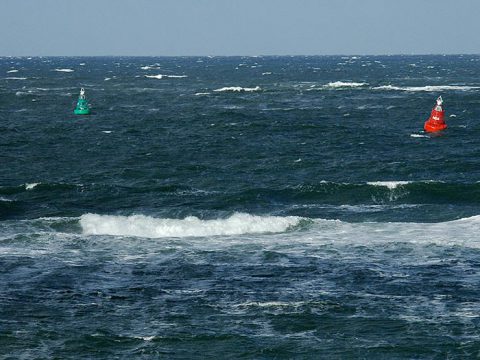
    Baltic Sea, foto fitis, sytske dijksen

    The major components of sea salt are chloride and sodium. The salt level in water is usually expressed in the amount of chloride. Freshwater contains between 0 and 200 milligrams of chloride. Brackish water contains 200 to 1000 milligrams and seawater more than 1000 milligrams.
    Seawater and freshwater can mix together in two ways. Seawater penetrates river arms during tidal movement and flows into fresh riverwater. Outer dike zones with brackish water result. Sometimes the zone is large when there is a large supply of riverwater in relation to the amount of seawater. In the wadden region, the Dollard and Jadebusen are mostly brackish. The entire Baltic Sea is also brackish. Brackish water can also be found inside the dikes. When sinking saltwater penetrates the dikes as seepage, it can mix with fresh inland water and become brackish.

  • Brackish ground
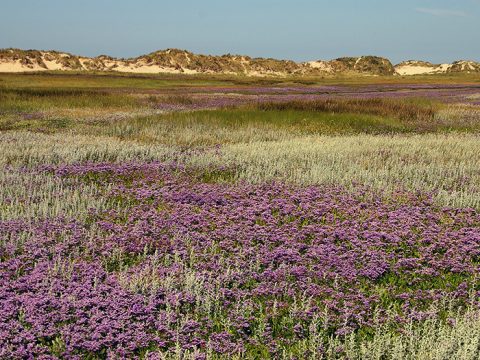
    Sea aster, foto fitis, sytske dijksen

    Crops are not very resistant to saline or brackish groundwater. When there are problems with penetrating salty groundwater in an agrarian region along the coast, then this produces undesirable saline soil. Water managers will try to prevent the seepage. On the other hand, managers of nature areas along the coast are very happy with salty groundwater in their terrain, because rare vegetation can develop in these brackish situations.
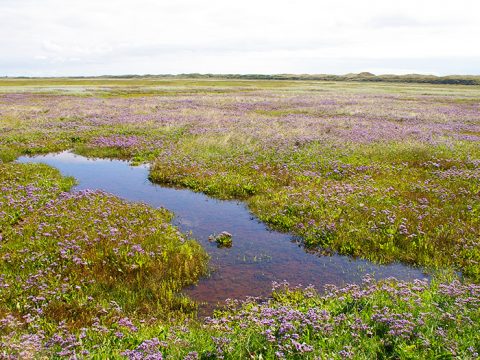
    Farmers cannot always grow the crops they desire in brackish water regions located inland of the dikes. Most crops will not grow in salty soils. However, there are types which will only grow under brackish conditions. These sorts are referred to as silty vegetables. Salicorn and sea aster are a couple of examples.

  • Present-day brackish water regions
    Zeeland, brackish water, foto fitis, sytske dijksen

    The majority of the delta waters used to be brackish. Due to the delta Works, many of these areas have become fresh or salty. The Veerse Meer, Lake Grevelingen and sections of the Westerschelde are still brackish, while the Oosterschelde and the Haringvliet are not. In South Holland, the brackish areas are limited to grounds on the landward side of the dikes by Goeree Overflakkee, Voorne, Putten, and in the Hoeksche Waard. Brabant has a few brackish water areas on its border with Zeeland. The Biesbosch used to be brackish. In North Holland, brackish water can be found behind the Hondsbossche Zeewering (sea wall), in the Wieringermeer and on Texel. The rest of the Wadden Islands, Friesland and Groningen have a few inland brackish water areas. The Dollard is a large offshore brackish water area. The Zuiderzee used to be one large brackish water region.

  • Extension of brackish water regions necessary
    Oosterschelde, foto fitis, sytske dijksen

    At a workshop on 17 September 1997, the RIKZ presented a study of the possibilities for extending brackish water areas in the Netherlands. This was a follow-up from the report 'Tussen Zilt en Zoet' ("Between Silt and Fresh"). All of those present agreed that extension of the area is desirable in view of enriching nature in the Dutch coastal areas. The report did not designate any places where this should occur. However, a discussion has begun as to whether or not the area should be extended within the borders of the present tidal flat region, or should it be seen as an extension of the tidal flat region at the cost of present cultured land. This discussion is being conducted mostly via the Interwad site on Internet.
    A simultaneous discussion is going on concerning the question of whether or not the fresh-saline transition between the Oosterschelde and the Krammer-Volkerak should be dealt with. Since the construction of the Volkerak (1969), the Oester and the Philips dams (1987), no water from the Maas and Rijn can enter the Oosterschelde. This was done purposely at the time to protect the region from the strongly contaminated river water. The Oosterschelde, however, changed from a river mouth (with a gradual change from fresh via brackish to saline water) to a permanently salty sea arm. Research and model studies from 1998 by the RIKZ and the RIVO showed that the natural quality and productivity of the Oosterschelde would significantly advance if there was a renewed flow of fresh water. Some of the typical marine species would disappear from the brackish section, however the majority of the existing fauna, including the shellfish stock, would be preserved. One expects that the eelgrass fields would return, and with a greater supply of nutrients, an increase in the amount of shellfish and zooplankton. The function as nursery for juvenile fish would also be strengthened.
    One problem with an eventual increased flow of fresh water into the Oosterschelde is the quality of the Maas and Rijn water. This is still so bad that it would be irresponsible to permit additional river water in from the Volkerakmeer (via the Zoommeer) or from the even more polluted Hollands Diep. In addition, the Volkerakmeer has too little water for this purpose.

  • Types of water bodies in brackish water regions

    Inner dike brackish water regions can be divided into various bodies of water: creeks, eddies, pools (´inlagen'), drinking pools and 'cart fields'.
    Creeks are remains of tidal channels that have become tide-less due to land reclamation. Older creeks are often slightly brackish. The fluctuations in the salt content are limited because of the large proportions. Since creeks are usually used for transporting water, they are often influenced by nutrients.
    Eddies are created by dike breaks. Deep ponds remain in the places where the water gushed through the hole in the dike. There is a limited fluctuation in the chloride level. Because of its isolated position, the nutrient level is often relatively low. Therefore, many eddies have a well developed vegetation of underwater plants and a characteristic fauna. The Terluchtse Weel is known for its colonies of bryozoans.
    Pools are strips of land between two dikes. The second dike was built in case the first dike failed. The material for the new dike was taken from the stroke between the two dikes, forming shallow brackish waters with a large surface area. The salt level in these pools can vary per season.
    Drinking pools are dug up and are meant to catch rainwater for livestock. If they are dug too deeply, they become influenced by salt intrusion.
    Cart fields form from digging up clay to build dikes. Trenches where the clay was removed lie 10 to 15 meters apart and fill up with brackish water. The land in between the trenches is where the carts rode to carry away the clay.

  • Typical species in brackish water
    Spiral Tasselweed, foto fitis, sytske dijksen

    In order to be able to survive in brackish water, a species must be tolerant to saline conditions as well as fresh water. There are not many species capable of that. Amphipods and common prawns can live in varying saline concentrations. Some kinds of water bugs and amphipods can live in conditions if they are not too saline. Characteristic plants are horned pondweed, brackish water crowfoot, beaked tasselweed and spiral tasselweed.