Content on this page requires a newer version of Adobe Flash Player.

Get Adobe Flash player


Search in the Encyclopedia

Dieren en planten

Water en land

Balgzand   Marshes   

Mens en Milieu

The marshes of the Balgzand

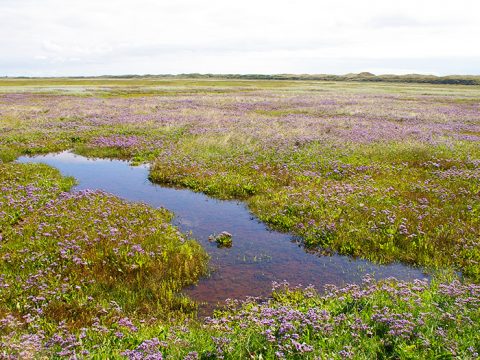
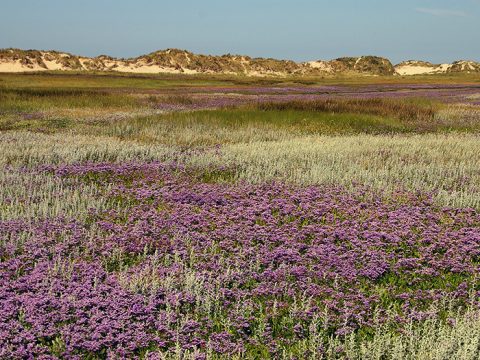
Salt marshes lie along the Balgzand dike. These grounds are exposed during high tide and therefore are used by thousands of birds as a high-tide refuge and foraging area. In the spring and summer, these marshes are also breeding grounds. The Bird Society has had a private contract with the government for this area and its surroundings since 1956, which was revised in 1980 to include the areas in the town of Den Helder. The purpose of the contract is to maintain and protect this area that is so important for the birds. The contract was transferred to Landschap Noord-Holland (the nature conservation society of North Holland) on 1 July 1994.

  • Fighting erosion

    Landschap Noord-Holland is looking for funding to prevent the salt marshes from eroding away. The situation in 2008 is very serious. Whether it is due to bottom subsidence from gas exploration which has started in the Wadden Sea or natural sea-level rising, the salt marshes are suffering from major erosion. If funding is not found, this will have significant consequences for thousands of tidal-flat birds that use marsh to rest during high tide, not to mention all the birds that use it for building their nests. The first distribution of funds from the Waddenfonds in 2008 did not include the request for this project.

  • Van Ewijcksluisschor

    This marsh consists of remnants of the dike construction in 1929 as well as the compensation marsh formed in 1984. It offers a resting area during high tide to shelducks, teal, wigeon, Brent geese, curlews and oystercatchers, to name just a few. A number of short-eared owls are regularly observed in the winter and it is important foraging grounds for Brent geese in the spring. Since the works have taken place, there has been a slight decline in the number of Brent geese. The reason is not just the fact that the original marsh has decreased in size, but that the suitable spots to forage for Brent geese lay along the old dike foot. Because the new dike foot lies 22 meters seaward, their favourite areas have disappeared. Thousands of terns, such as common terns and black terns use the newly constructed part of the marsh to sleep in the late summer. Wigeon and Brent geese have also discovered the new marsh and are regularly seen foraging. The original grass which was seeded after the works were completed has mostly been overgrown with marsh vegetation.
    Lots of sedimentation takes place on the southeastern side and at the head of the marsh. In fact, the marsh has already grown several dozens of meters since the construction took place. Much erosion occurs on the side with lots of wind and currents. The inlet between the old and new marsh has filled up with mud over the years.
    A large black-headed gull colony (5000 pairs) has been on the old part of the marsh during breeding season for many years, while a common tern and avocet colony (800 and 250 pairs, respectively) has formed on the newly laid area. Since 1997, Arctic terns have also been breeding here.
    In 1979, volunteers from the local bird watching groups helped to construct a number of brushwood dams for the marsh. The purpose was to try to compensate the expected erosion. Even though this project did not totally fulfill the expectations, nesting opportunities for the common tern have been created.

  • Kooihoekschor

    This marsh borders the Balgzand dike at the point where the Spuikanaal (sluice canal) splits off from the Balgzand canal. It has three different parts: the northern part consisting of a large unbroken surface of around ten hectares; the central area where the elevation ranges from 0.70 to 1.70 meters above sea level; and the eastern part, which lies around 1.20 meters above sea level.
    The marsh is very important for many species of ducks during high tide, for example, shovelers, northern pintails and wigeon. Massive numbers of Brent geese use the area to forage in the spring and during high tide, tens of thousands of knots and dunlins take refuge here. The area is an important nesting area for avocets and common terns. The Kooihoekschor is the most threatened marsh, particularly due to the developments in the nearby industrial area Oostoever. The gas company of the NAM has almost made it unsuitable for the marsh to serve as a sleeping area. Even the high-tide refuge function has strongly declined. There is a possible relationship between the use as sleeping area and high-tide refuge. The less critical species, such as oystercatchers and herring gulls, continue to use the marsh in massive numbers.
    Regular disturbances from low-flying planes and helicopters occur at the nearby airfield De Kooy. The Kooihoekschor is only used as a high-tide refuge for massive numbers when there is an emergency, such as disturbances and extremely high water levels in other areas.